
October 8, 1939: Lazio Genova 1893 4-1

A Second-Half Masterclass
Lazio turned a goalless first half into a spectacular victory, overwhelming a strong Genova side with five goals after the interval.
The season so far
Lazio, as usual, did not have much money for the summer transfers. All the same, three interesting players arrived from South America: Evaristo Barrera, Silvestro Pisa plus Enrique Flamini. They all arrived via boat in February 1939 together with many other “oriundi” trying to be signed by an Italian club. The three could not play in the 1938-39 season so they were signed for the next one.
The Biancocelesti also had a new manager, Kertesz Geza, who substituted Luigi Allemandi.
They had drawn the first two games of the season and won in Florence. Time to win at home.
The match: Sunday, October 8, 1939, Stadio PNF, Rome
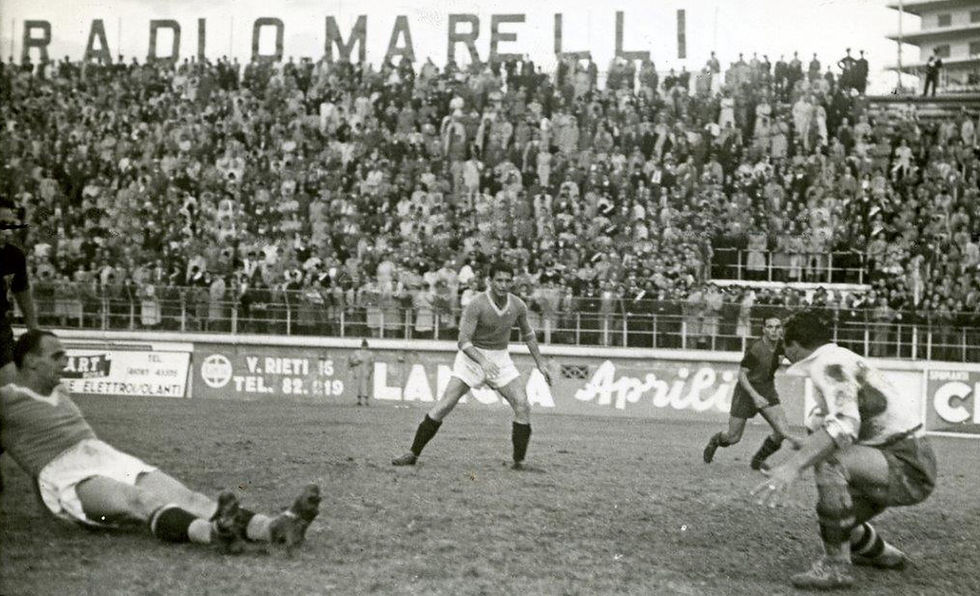
Lazio produced a remarkable second-half performance to sweep aside a strong and determined Genova side 4–1, with all five goals arriving after the break. The scale of the victory was all the more impressive given the quality of the opposition, who had matched Lazio for much of the first half and appeared to have the better of the tactical battle.
Genova began confidently and created several good opportunities. Giacomo Neri and Ugo Conti both went close in the opening minutes, while Athos Miniati also missed a presentable chance before half-time. Lazio, meanwhile, struggled to find a way through a well-organised red-and-blue defence. When the teams went into the interval goalless, there was every reason to believe that Genova's tactical approach had been justified.
Everything changed after the restart.
Lazio broke the deadlock in the third minute. Umberto Busani delivered an excellent cross and Silvestro Pisa made an intelligent run into the area, meeting the ball with a well-directed header that gave Lino Fregosi no chance.
Four minutes later, Pisa struck again. Receiving the ball around 25 metres from goal, he unleashed a fierce shot which Fregosi managed to touch but could not keep out. Lazio suddenly led 2–0 and Genova's confidence began to disappear.
The turning point had arrived.
Genova had shown considerable attacking ability before the interval, but their chances had not been converted. After Lazio's second goal, the visitors struggled to reproduce that threat. Giovanni Battistoni, already playing with his nose heavily protected after an early collision with Silvio Piola, was increasingly hampered by his injury, while Elisio Gabardo was less effective on the heavy pitch as the match progressed. The Genova attack gradually became isolated, with Neri and Conti particularly disconnected from the game.
Lazio, by contrast, grew in confidence.
Luigi Vettraino was central to the transformation. He repeatedly moved into a central position during Lazio's attacks, effectively creating a second centre-forward alongside Piola. The movement unsettled the Genova defence and created space for Lazio's other attackers.
It was an apparently simple tactical adjustment, but an extremely effective one.
In the 28th minute Vettraino moved towards the right side of the area during an attack involving Busani and Piola. His movement drew the Genova defenders out of position before he switched the ball to the opposite side, where Enrique Flamini was completely unmarked. From around 15 metres, Flamini calmly beat Fregosi to make it 3–0.
Six minutes later, Vettraino did it again. After combining with Flamini, he moved centrally and once more dragged the Genova defence out of position. He then released the ball towards the right, where Piola had found himself completely free inside the area. Piola made no mistake, sending a low shot beyond Fregosi for Lazio's fourth.
The game was effectively over.
Genova did have chances late on. In the 42nd minute, Conti set up Bruno Arcari from close range, but his effort flew up onto the crossbar. Two minutes later, however, the visitors finally found the net. Neri sent a dangerous low ball across the area and Maximiliano Faotto's attempted clearance went horribly wrong, the Lazio defender slicing the ball into his own goal despite Giacomo Blason's desperate attempt to keep it out.
The goal provided Genova with little more than consolation.
The final score, 4–1, did not fully reflect how competitive the match had been for an hour. Genova had demonstrated why they were considered a strong side, but Lazio's second-half attacking brilliance completely changed the contest. Once the breakthrough came, the visitors were unable to reorganise and Lazio exploited the spaces with increasing confidence.
The victory was therefore more than a routine three points. Lazio had overcome a sophisticated and physically demanding opponent by adapting intelligently during the match. Once Vettraino began moving centrally and combining with Piola, Genova's defensive structure was unable to cope.
Who played for Lazio
Manager: Kertesz
Who played for Genova 1893
Fregosi, Marchi, Sardelli, Genta, Battistoni, Villa, Neri, Arcari (IV), Miniati, Gabardo, Conti
Manager: Garbutt
Referee: Rosso
Goals: 52' Pisa, 55' Pisa, 73' Flamini, 77' Piola, 89' Faotto (og)
What happened next
Lazio played really well and arrived 4th just behind Juventus. It could have gone even better but some losses denied the team a better position. However, Ambrosiana Inter who won the scudetto and Bologna were way too strong.
Alfredo Monza and Ramella were the ones who played most games (33 in total between Serie A and Coppa Italia) and obviously Piola was the leading goal scorer (10).
Serie A finished on June 2 1940. Eight days later, on June 10, Benito Mussolini declared war on France and Great Britain.
Lazio Jersey 1939-40

The 1939-40 season saw the Lazio shirt take on a slightly deeper shade of celeste, moving towards a more distinctly blue tone. The shirt was produced in a solid celeste colour, with the shade noticeably darker than the traditional pale blue associated with Lazio. The collar appeared in white, with two versions documented during the season: a simple round neck and a wider V-neck. Both featured a ribbed, knitted finish.
But the most significant change was not the colour or the collar.
For the first time, Lazio players wore numbers on the backs of their shirts.
The change came as part of a major development in Italian football. In September 1939, FIGC president Giorgio Vaccaro issued a circular making shirt numbers compulsory in Serie A, Serie B, Serie C and Prima Divisione, following the British model. The Italian national team had already begun using numbered shirts, but the 1939-40 season marked their introduction into the domestic championships.
The numbers were large, made from felt or cloth and sewn onto the shirts by hand. They were intended to make players easier to identify, particularly for radio commentators, at a time when football broadcasting was becoming increasingly important. The federation even established a direct relationship between the number and the player's position: No. 1 for the goalkeeper, Nos. 2 and 3 for the full-backs, No. 9 for the centre-forward and No. 11 for the left winger.
For Lazio, the first numbered match came on 17 September 1939 against Modena. The game ended 1-1 and entered club history as the first time the Biancocelesti took to the field wearing numbered shirts.
One number, however, would quickly become particularly significant.
No. 9.
It belonged to Silvio Piola.
Piola had joined Lazio in 1934 and had spent his first five seasons in Rome playing without a number on his back, as was customary in Italian football. From 1939 onwards, the No. 9 became permanently associated with him. It was the number worn by one of the greatest goalscorers in Italian football history and would remain an enduring symbol of Piola's Lazio career.
A simple celeste jersey, a white collar and a piece of white cloth sewn onto the back — yet together they marked the beginning of one of the most recognisable traditions in Lazio's history.
Sources


Comments