
November 16, 1975: Lazio Roma 1-1

Chinaglia saves Lazio in a stormy derby
In torrential rain at the Olimpico, Roma took the lead through De Sisti and looked set to claim the points. But Lazio refused to give in, and Chinaglia rescued a draw with twelve minutes remaining in a fiercely contested encounter.

The season so far
The previous season Lazio had arrived fourth. The team was deeply affected by their manager’s illness.
Tommaso Maestrelli had cancer so he could not lead the Biancocelesti for the 1975-76 season. President Umberto Lenzini had waited until the last possible moment, and then he was forced to look elsewhere. The new manager was Giulio Corsini, a young trainer who had done well with Atalanta.
Corsini’s idea was to get rid of some of the players that had been the backbone of the scudetto team. So goodbye Mario Frustalupi and Giancarlo Oddi, who were sold to Cesena in exchange for Paolo Ammoniaci and Francesco Brignani, plus Franco Nanni, sold to Bologna.
The other signing of any significance was Antonio Lopez from Pescara.
Giorgio Chinaglia was a problem.
Long John’s family had been forced to return to the US following threats by Roma supporters. Chinaglia really missed his family so in the summer he went to the States. While he was there he was invited to play a game for the Hartford Bicentennials against Poland. His participation was a media event and Chinaglia felt very important.
Pele joined the New York Cosmos and Chinaglia was invited to see the Brazilian champion’s first game with the club. While he was there he asked if Cosmos would want to sign him too.
He really missed his family and he felt that life without them, the current difficult situation in Italy, plus Maestrelli’s illness were a sign that his Lazio adventure was over. Lenzini refused any negotiations and threatened Chinaglia with fines and suspension. Long John was forced to come back to Rome but when he arrived he saw that some of his teammates had been sold and that the new manager wanted to rule. Chinaglia demanded to play in Coppa Italia as soon as he returned, the manager said no. War had begun.
In Coppa Italia Lazio did rather well, qualifying for the second phase, which would be played at the end of the campionato. They won their two matches at home and drew the two away games.
In the UEFA Cup Lazio faced Chernomorets Odessa in the first round. After losing 1-0 away in the first leg, Lazio managed to take the tie to extra time thanks to a Chinaglia penalty with one minute to go. Long John then scored another two goals and the Biancocelesti went through.
They then were drawn against Johan Cruijff’s Barcelona. A few weeks before the first leg, General Francisco Franco had ordered a few dissidents shot and this had created great indignation in Italy. There was strong pressure from Italian politicians on Lazio to refuse to play against the Spanish team. Lenzini did what he could to get the game played, but in the end gave up.
As a consequence, UEFA gave the victory to the Spaniards 3-0. The return game was pointless and the Biancocelesti, packed with reserves, lost 4-0. The stupidity of the decision was blatant: Barcelona and Catalunya had always been against Franco.
So far, the Biancocelesti had played five games. After winning away with Sampdoria then then drew two and lost both matches played away. They were currently 13th on four points.
The match: Sunday, November 16, 1975, Stadio Olimpico, Rome
The first Rome derby of the 1975-76 season was played on Sunday, 16 November 1975, at the Stadio Olimpico.
The weather was dreadful, with heavy rain throughout the afternoon leaving the pitch waterlogged and making conditions extremely difficult. Around 55,000 spectators attended, although the downpour kept many away from what would normally have been a capacity crowd.
There was also considerable tension within the Lazio camp. The relationship between coach Giulio Corsini and Giorgio Chinaglia had deteriorated badly during the preceding week, with the striker unhappy at being refused permission to travel to New York to visit his family. The dispute would come to a head after the derby.
The match itself began at a lively pace. Chinaglia was involved in Lazio's first attacking move, but Roma soon threatened through Francesco Rocca, whose effort was blocked by Luigi Polentes. Lazio responded with a cross from Chinaglia that was met by Renzo Garlaschelli with a spectacular diving attempt, only for Sergio Santarini to clear. At the other end, Carlo Petrini forced Felice Pulici into a save.
Both sides continued to create chances. Ciccio Cordova tested Pulici with a free-kick, while a promising run by Roberto Badiani, set up by Sergio Petrelli, ended with a shot comfortably saved by Paolo Conti. Pulici then produced an excellent stop to turn away a powerful long-range effort from Giorgio Morini.
Badiani came close to scoring when his dangerous cross struck the crossbar, while Luciano Re Cecconi wasted a good opportunity after combining with Bruno Giordano. Just before half-time, Pulici made another decisive intervention, denying Cordova when the Roma midfielder found himself clean through on goal.
The second half began with Roma applying pressure. Petrini twice tested Pulici following a corner, while Conti was called into action to deal with a shot from Francesco Brignani.
The breakthrough came in the 54th minute. Following an elaborate Roma move, the ball reached Giancarlo De Sisti after a clearance by Paolo Ammoniaci. The midfielder struck a superb shot beneath the crossbar to give the visitors the lead. Lazio protested, claiming that Valerio Spadoni had been offside during the build-up, but referee Sergio Gonella allowed the goal to stand.
Lazio threw themselves forward in search of an equaliser, sometimes leaving dangerous spaces at the back. Roma nearly took advantage. Petrini was denied by Pulici after a rapid Rocca run, and the Lazio goalkeeper again saved from the same forward a minute later. At the other end, Garlaschelli found himself alone in front of Conti but fired over. Corsini introduced Vincenzo D'Amico for Giordano in the 63rd minute, hoping to add greater unpredictability to the attack.
Roma continued to look dangerous. Cordova produced an impressive individual run in the 68th minute, beating several defenders before Pulici came off his line and blocked his attempt with his foot. The goalkeeper was left dazed after the collision, but had once again kept Lazio in the game.
Chinaglia then came close to equalising with a spectacular free-kick in the 71st minute. Conti dived to save, and Garlaschelli's follow-up was also brilliantly blocked by the Roma goalkeeper. A minute later, however, Lazio survived a potentially decisive counterattack. After a corner, Morini ran almost the length of the pitch and crossed for Petrini, whose hesitation allowed Pulici to intervene.
The escape gave Lazio renewed impetus. Just a minute later, after a frantic scramble inside the Roma penalty area, Chinaglia found the net with a shot to bring the scores level at 78 minutes. The Olimpico erupted, and the momentum had shifted.
Lazio even had an opportunity to win the derby. In the 85th minute, Chinaglia fired straight at Conti when better placement might have produced the winner. De Sisti then tried his luck from distance, but Pulici turned the ball behind for a corner.
The final whistle confirmed a 1-1 draw. Roma had taken the lead and enjoyed dangerous spells, but Lazio's persistence and Pulici's outstanding performance ensured that the Biancocelesti were rewarded for their determination. It was a hard-earned point in difficult conditions, and one that felt particularly valuable given the circumstances surrounding the team.
That evening, Chinaglia flew to the United States, with the tacit approval of Corsini and the blessing of club president Umberto Lenzini. The derby had ended in a draw, but the tension between the striker and his coach was far from over.
Who played for Lazio
F.Pulici, Ammoniaci, Petrelli, Polentes, Ghedin, Re Cecconi, Garlaschelli, Brignani, Chinaglia, Badiani, Giordano (63' D'Amico)
Substitutes: Moriggi, Manfredonia
Manager: Corsini
Who played for Roma
Conti P., Peccenini, Rocca F., Cordova, Santarini, Batistoni, Boni L., Morini, Petrini C., De Sisti, Spadoni
Substitutes: Quintini, Negrisolo, Bacci
Manager: Liedholm
Referee: Gonella
Goals: 54' De Sisti, 78' Chinaglia
What happened next
Lazio lost the next game at Ascoli and Corsini was sacked. Lazio were 13th, in the relegation zone with just 5 points.
Tommaso Maestrelli was feeling much better and had returned almost to a normal life. Lenzini offered him his job back and the Maestro accepted.
But there were problems. Lazio did not have a playmaker since Frustalupi had been sold. Lots of runners, but nobody to feed the ball to the forwards.
The Biancocelesti struggled all season. With four games to the end, Lazio were third from bottom, one point behind Sampdoria and Ascoli. Three teams went down (two points for victory). The Biancocelesti had to play against Torino who were Serie A leaders. Lazio scored in the second half but an unfortunate own goal with 60 seconds to go gave Torino the equaliser. With three games left, Cagliari were doomed on 15 points, Como had 18, Lazio and Sampdoria 20, Ascoli 21 and Verona 22.
The Torino game was Chinaglia’s last ever for Lazio. He left that evening to join New York Cosmos. His last goal had been against Ascoli on March 21.
Lazio lost the next match 4-3 in Florence. So now Como and Lazio were on 20, Ascoli 21, Verona and Sampdoria 22. Lazio needed to beat AC Milan in the last game at home and they did. Not only, they literally destroyed them, scored four goals and could have scored many more.
Como had 20 points, Lazio, Sampdoria and Ascoli 22, Verona 23. Last match at Como. After 17 minutes the Biancocelesti were 2-0 down but then Giordano managed to pull one back. At the end of the first half the situation was Lazio and Como on 22 points, Ascoli, who were winning against Roma, on 24, Sampdoria, who were 1-0 up against Napoli, also on 24, as were Verona who were losing in Florence.
In the second half, Badiani equalised and the Biancocelesti managed to bring back the necessary point that allowed them to reach safety. Lazio and Ascoli were on 23 points but the Biancocelesti had a better goal difference so it was Ascoli who joined Como and Cagliari in Serie B.
Great celebrations and tears of joy at the end of the game. But there was still a problem.
We mentioned that Frustalupi and Oddi had been sold to Cesena in the summer of 1975. Lazio, however, still owed them some money. Furthermore, in the home match, the Cesena goalkeeper Lamberto Boranga had had his car damaged by some Lazio fans (in 1971 Boranga had feigned being hit by Chinaglia during a game and Long John had been sent off) and Lazio had promised to reimburse him. So, when Lazio went to Cesena in April 1976, the club took the opportunity to pay off their debts.
CORRUPTION!!!! Lazio have bribed the Cesena players!!! There was an enquiry and nothing happened but the club and tifosi had to wait until the end of July to be certain.
At the end of a complicated season there was the second phase of the Coppa Italia to play. The eight winners of the first phase groups were divided into two groups of four. Lazio had to play against Verona, Inter and Genoa. In the end they arrived third, just one point behind leaders Verona who qualified for the final (which they lost to Napoli).
Lazio jersey 1975-76
Image Sources: SS Lazio Museum (first and last), Football Kit Archive (fourth). The others were created with AI.
The 1975-76 season was one of the most interesting in Lazio's kit history. Rather than relying on a single design, the club used a succession of different shirts, reflecting the changing fashions of the period and the growing influence of the Dutch national team and Ajax.
The concept of Total Football had become a worldwide phenomenon, and its influence extended beyond tactics and playing style to the appearance of footballers themselves. Lazio, like many other European clubs, was clearly fascinated by the Ajax model.
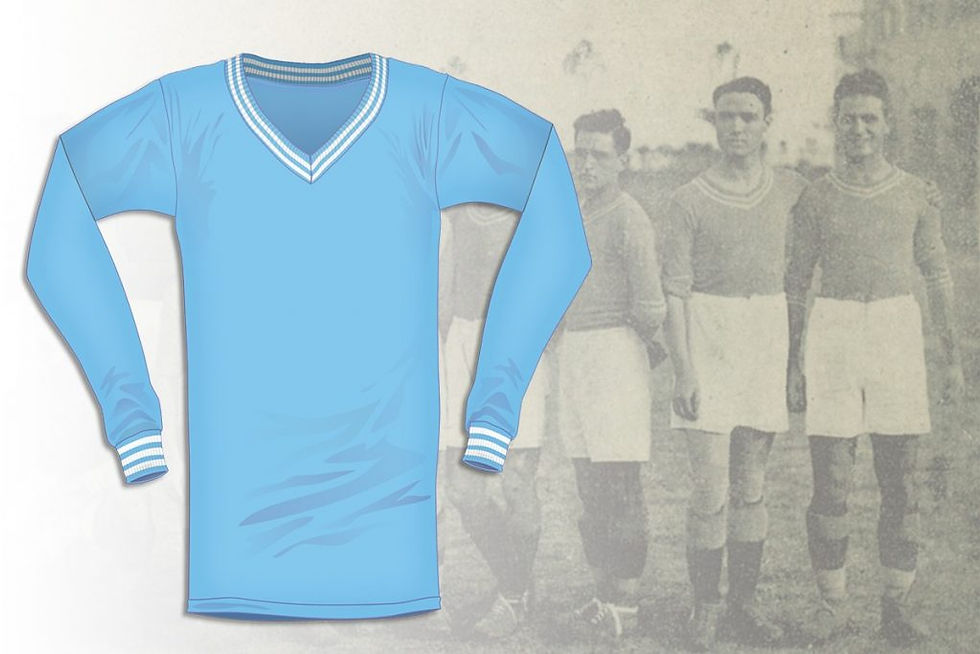
The Biancocelesti began the campaign wearing a short-sleeved sky-blue shirt with a white collar and white sleeve edges. It was a relatively simple design, retaining the traditional colours but giving them a clean, distinctive finish. However, it was used only during the opening four league fixtures, the last being the 1-1 draw against Bologna. For the following match away to Juventus, Lazio returned to the long-sleeved winter shirt from the previous season.
A further change came in December, when the team wore again the special English-made shirt introduced during the previous campaign. This model was characterised by a prominent white collar and a large white triangular insert extending down the chest. It was an unusual and immediately recognisable design, although the tricolour Scudetto badge was no longer present.
On 4 January 1976, against Cesena, Lazio introduced another variation. The shirt was a model already seen during the 1973-74 championship, but this time it featured a considerably darker shade of blue, closer to azzurro than the traditional celeste. It had a V-neck and two-coloured cuffs. Produced by Ennerre, the shirt also introduced a new detail: the numbers were now designed in an Anglo-Saxon style, giving the kit a more modern appearance.
The following week brought the most striking innovation of the season. On 11 January 1976, away to Torino, Lazio wore a special white shirt with a broad central sky-blue band. The inspiration from Ajax was unmistakable. The numbers on the back were particularly interesting: instead of the usual plastic material, they were embroidered directly onto the fabric. Unfortunately, the new design did not bring much luck. Lazio lost both matches in which it was worn, against Torino and Milan, and subsequently returned to the more familiar Ennerre shirt.
The Dutch influence returned in March, this time with the colours reversed. For the derby against Roma on 14 March, played away from home, Lazio wore a sky-blue shirt with a broad white central band. It was effectively the Ajax design in reverse, perhaps chosen for good luck. On this occasion, the experiment proved more successful, as the Biancocelesti came away with a goalless draw.
From the following match against Ascoli on 21 March, Lazio once again adopted the traditional Ennerre model. It remained in use until 9 May, when the team faced Milan at the Olimpico and brought back the short-sleeved shirt worn at the beginning of the season. This version, produced by Tuttosport, provided a final reminder of the kit with which the campaign had started.
There was one more surprise before the season ended. For the final Coppa Italia group match against Genoa on 26 June 1976, Lazio introduced an especially lightweight shirt. With the game taking place in the heat of early summer, Tuttosport replaced the traditional brushed wool fabric with fresh, lightweight cotton. The shirt had a particularly intense shade of celeste, almost turquoise, and a Tuttosport label sewn inside the collar.
The 1975-76 season therefore stands out as a fascinating chapter in Lazio's kit history. From the traditional short-sleeved shirt to the darker Ennerre version, the two Ajax-inspired designs and the lightweight summer model, the club experimented with colours, materials and details in a way that was unusual for the time. It was a season in which the Lazio shirt became a reflection of football's changing aesthetic, as well as a symbol of the club's identity.
Sources


Comments