
September 4, 1985: Lazio Monopoli 2-0, Coppa Italia

Two goals, but not enough
Lazio beat Monopoli 2–0 at the Flaminio, but the result was insufficient to send them through to the Coppa Italia knockout stages

The season so far
The 1984-85 season had seen Lazio relegated to Serie B. This meant that there had to be a revolution in the team to sign players that could adapt to the new circumstances. President Giorgio Chinaglia, keen to amend the disastrous season where he had made many mistakes, chose Gigi Simoni as manager. Simoni had been able to help promote Genoa (twice) and Brescia to Serie A plus Pisa the previous season, so he was considered the best possible manager for Lazio.
As far as players were concerned, goodbye Bruno Giordano, Lionello Manfredonia, Joāo Batista, Michael Laudrup among many, and welcome Domenico Caso, Giuliano Fiorini, Fabio Poli, Roberto Galbiati, Giorgio Magnocavallo and Astutillo Malgioglio.
But there was a big financial problem. Chinaglia was sure he would get money from the US but this was not happening. Dark clouds were hovering over the club.
In the meantime, the season started with the Coppa Italia group stage. Lazio were paired with Atalanta, Sampdoria, Monopoli, Taranto and Catania. After having beaten Catania in the first game, they drew 2-2 in Bergamo coming from two down, drew at Taranto and at home with Samp. Coming into the final game against Monopoli at the Olimpico the table read: Atalanta 6 points, Sampdoria 6, Lazio 5, Monopoli 4, Catania 2, Taranto 1, the top two teams would go forward. Last decisive games: Samp-Atalanta and Lazio-Monopoli. The goal difference would probably be fundamental: Samp and Atalanta were on +4, Lazio on +1.
The match: Wednesday, September 4, 1985, Lazio Monopoli 2-0, Coppa Italia
Lazio completed their Coppa Italia group campaign with a convincing 2–0 victory over Monopoli at the Stadio Olimpico but once again found themselves cruelly denied qualification. Gigi Simoni's side needed to win by four goals to be certain of progressing, but despite dominating virtually the entire match and creating a succession of chances, they could only find the net twice. With Sampdoria and Atalanta drawing 2–2 in Genoa, the result left Lazio level on points with both sides but behind on goal difference.
The frustration was all the greater because Lazio had produced an impressive series of performances during the group stage. They had developed a recognisable style under Simoni, combining organisation with attacking football, and had gone into the final match knowing exactly what was required. Yet the four-goal target proved beyond them.
From the opening whistle, Lazio laid siege to the Monopoli goal. Mimmo Caso was particularly dangerous on the right, repeatedly finding space and supplying crosses. After only three minutes he picked out Giuliano Fiorini, whose header flew over the bar. Two minutes later Lazio thought they had taken the lead when Giorgio Magnocavallo headed Caso's delivery into the net, but the goal was disallowed for an alleged offside involving Oliviero Garlini. The decision provoked loud protests from the home crowd.
The chances continued to arrive. On 20 minutes Fiorini produced an excellent pass for Garlini, who was completely unmarked in the area but headed over. Three minutes later Garlini exploited a misunderstanding between goalkeeper Sandro Mancini and defender Amelio Puce, only to hesitate when presented with the opportunity to shoot. The collision between the two Monopoli players was so severe that Puce had to be carried off the pitch on a stretcher.
Lazio finally got their reward after half an hour. Once again Caso was at the heart of the move, taking a free-kick quickly and finding Gabriele Podavini in space on the right. The defender advanced into the area and calmly sent a low shot beyond Mancini to give Lazio a deserved lead.
The pressure continued. Magnocavallo came close when his shot was deflected towards goal, only for a Monopoli defender to make a desperate clearance just before the ball crossed the line. Lazio went into half-time ahead but knowing that three more goals were still required.
The second half proved considerably more frustrating. Lazio's tempo dropped after the huge effort of the opening period, while Monopoli remained camped in front of its own goal. Lazio did find the net again around the hour mark, but this time the officials were correct to disallow it: Caso's shot was heading into the net, but Fiorini, who followed up the effort, was in an offside position. The decision prompted angry reactions in the stands, and Monopoli goalkeeper Mancini briefly collapsed after apparently being struck by an object thrown from the crowd. He was treated and was able to continue.
As the minutes passed, Lazio began to realise that the required four-goal margin was slipping away. Caso, who had been the principal source of attacking inspiration, faded physically, and nobody in midfield was able to replace his creativity. The attacks became increasingly predictable.
There was still time for another surge. With 14 minutes remaining, Francesco Dell'Anno's free-kick was deflected by Caso onto the crossbar. A minute later Monopoli were reduced to ten men when Aldo Finetto, already booked, was sent off for a foul on Magnocavallo. Lazio now had a numerical advantage, and finally found their second goal in the 85th minute.
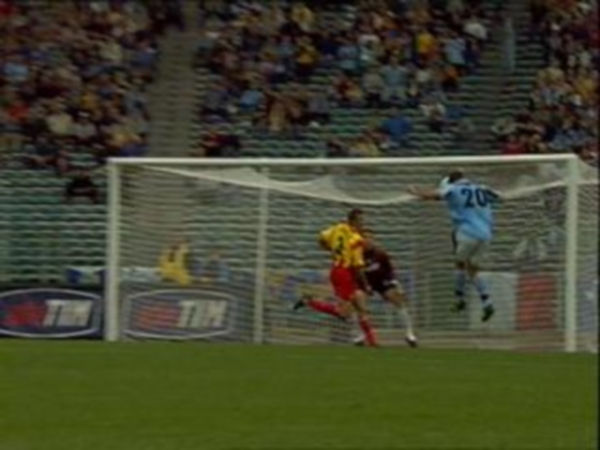
Magnocavallo launched Dell'Anno down the left, and the substitute reached the area before anticipating Mancini and delivering the ball towards Caso. The winger rose to head the ball into the net and make it 2–0.
Lazio pushed desperately for the third and fourth goals. Mancini denied Fabio Poli and Dell'Anno in quick succession, while Fiorini struck the crossbar with a late header. The final whistle confirmed a 2–0 victory—but also Lazio's elimination.
It was a particularly painful exit. Lazio had won three of their five group matches and remained unbeaten, yet the two draws against Atalanta and Sampdoria ultimately proved decisive. The failure to convert their overwhelming superiority against Monopoli into the necessary goals meant that Simoni's team were left to reflect on what might have been.
For Monopoli, surviving with only a two-goal defeat was enough to play a decisive role in the qualification battle. For Lazio, it was another case of playing well but being punished by the unforgiving mathematics of the Coppa Italia group stage.
Who played for Lazio
Malgioglio, Podavini, Calisti, Galbiati, Calcaterra, Magnocavallo (89' Toti), Poli, Vinazzani (64' Fonte), Fiorini, Caso, Garlini (35' Dell'Anno)
Manager: Simoni
Who played for Monopoli
S.Mancini, Puce (25' Primizio), Brancale, Prestanti, Bettinelli, M.Orsi (46' Aguzzoli), Silva (70' Di Michele), Cerri, Lanci, Finetto, Quaranta
Substitutes Stenta, Sante
Manager: Colautti
Referee: Boschi
Goals: 30’ Podavini, 85’ Caso
What happened next
The increasingly desperate financial situation forced Chinaglia to resign as president in December. The new president, Franco Chimenti, could not sustain the financial commitment alone so he started looking for partners. Giorgio and Gian Marco Calleri arrived and helped out, so at least a part of the wage debt could be paid off. Chimenti then made the mistake of confirming Simoni for another year without telling his new partners. The Calleri brothers backed out of Lazio and asked for their money back. Chimenti tried to look for new investors but found none. Lazio were bust.
At this point, fortunately the Calleri’s came back but they did not want to do it alone. Renato Bocchi, a Parma born entrepreneur who had always lived in Rome, came in and bought 51% of the club with the other 49% left to the Calleri brothers. Lazio were saved.
On the pitch, things did not go well. Financial insecurity and injuries were not helping. Despite being one the favourites on paper, the situation was not looking good. At home Lazio did not do too badly but away from home the results were terrible. At the end of the first half of the season Lazio were 10th, three points away from the promotion zone.
The last boat for Serie A was against Vicenza at home on March 2. Lazio went two goals up, then 3-2 but in the end lost 3-4 due to a mistake by Malgioglio. The goalkeeper, who had not had a good season, after the umpteenth insult from fans, took off his jersey and spat on it. Not a good idea. He was sacked.
In the ten games after the match against Vicenza, Lazio won just one and had not scored a goal in the last four matches. They were 14th together with Pescara, Perugia and Palermo, one point ahead of Sambenedettese and two above Catanzaro.
The situation was dramatic. The next game was against Catanzaro who needed to win to keep their own hopes alive. Lazio desperately needed to wake up. They managed to win 3-2 in Calabria hence avoiding any worries of relegation.
In the last match of the season Lazio beat Brescia 4-2. It was the last Lazio game for many players including fan favourite Vincenzo D’Amico.
A difficult year for Lazio. Oliviero Garlini was the player with most appearances (43) and the top scorer (18).
There was hope for the future but dark clouds were already looming over Lazio.
What Happened in Serie B 1985-86

In the previous season, Pisa, Lecce and Bari had been promoted to Serie A, while Ascoli, Lazio and Cremonese had been relegated.
For obvious reasons, the three clubs that had played in Serie A the previous season were among the favourites for promotion in 1985-86. Perugia and Triestina, who had narrowly missed out the previous year, were also expected to challenge for a place in the top flight.
September
Triestina won their first three games and moved to the top of the table, followed by a large group of teams including Lazio, who had played all three of their opening matches at the Olimpico.
Triestina 7, Ascoli 6, Lazio 6, Cesena 6, Brescia 6, Sambenedettese 6, Genoa 5, Vicenza 5, Cagliari 5, Empoli 4, Catanzaro 4, Bologna 3, Pescara 3, Palermo 3, Catania 3, Cremonese 2, Monza 2, Arezzo 2, Campobasso 1, Perugia 1
October
On the sixth matchday, Lazio beat Triestina at home to move to the top of the table, level on points with Cesena, Brescia and Sambenedettese. Two games later, only Ascoli remained alongside Lazio at the summit.
The Biancocelesti had won all five of their home matches but had struggled somewhat away from the Olimpico.
Ascoli 11, Lazio 11, Cesena 10, Brescia 10, Sambenedettese 10, Triestina 10, Genoa 9, Vicenza 9, Empoli 9, Pescara 8, Bologna 8, Catania 8, Catanzaro 7, Perugia 7, Cremonese 6, Monza 6, Arezzo 6, Cagliari 6, Palermo 5, Campobasso 4
November
The big match on the tenth matchday saw Lazio face Ascoli, but the game ended goalless. The Biancocelesti lost ground and were overtaken by Cesena, Sambenedettese and Brescia.
Ascoli 16, Cesena 15, Sambenedettese 15, Brescia 14, Lazio 13, Genoa 13, Vicenza 13, Bologna 13, Triestina 13, Cremonese 12, Empoli 12, Pescara 11, Monza 11, Catanzaro 11, Perugia 11, Arezzo 10, Palermo 10, Catania 10, Campobasso 9, Cagliari 8
December
The race remained extremely tight, with every team except Ascoli within eight points of the leaders. With the season approaching its halfway point, almost anything was still possible.
Ascoli 23, Cesena 20, Vicenza 18, Brescia 18, Triestina 18, Genoa 17, Lazio 17, Empoli 17, Cremonese 16, Bologna 16, Sambenedettese 16, Catania 15, Catanzaro 15, Pescara 14, Palermo 14, Campobasso 14, Perugia 14, Arezzo 13, Cagliari 13, Monza 12
January
Ascoli had opened up a four-point lead as the promotion picture continued to change. Lazio were losing ground, largely because they continued to struggle for victories away from home.
Ascoli 29, Brescia 25, Vicenza 24, Triestina 23, Cesena 22, Empoli 22, Cremonese 21, Bologna 20, Genoa 20, Sambenedettese 20, Lazio 20, Campobasso 19, Palermo 18, Perugia 18, Catania 18, Pescara 17, Arezzo 17, Catanzaro 17, Cagliari 16, Monza 14
February
Brescia picked up relatively few points during February, allowing Ascoli to establish themselves at the top of the table. The battles at both ends remained extremely tight.
Ascoli 35, Brescia 29, Cesena 28, Vicenza 28, Empoli 28, Genoa 27, Triestina 27, Cremonese 25, Bologna 24, Lazio 24, Sambenedettese 23, Perugia 23, Palermo 22, Campobasso 22, Pescara 21, Arezzo 21, Catania 21, Catanzaro 19, Cagliari 18, Monza 15
March
Lazio effectively abandoned any remaining hopes of promotion after losing 4-3 at home to Vicenza. The defeat left the Biancocelesti surprisingly close to the relegation zone.
Ascoli had also slowed down, losing the big game away to Brescia, allowing the chasing pack to close the gap. At the other end, Monza were now in serious danger of dropping into Serie C.
Ascoli 37, Brescia 36, Vicenza 35, Empoli 34, Genoa 32, Cesena 31, Triestina 31, Bologna 29, Cremonese 27, Palermo 27, Sambenedettese 27, Lazio 27, Campobasso 27, Perugia 25, Arezzo 25, Cagliari 24, Pescara 23, Catania 23, Catanzaro 23, Monza 17
April
With seven games remaining, Ascoli and Brescia had established a five-point advantage over fourth-placed Empoli. Vicenza were three points clear of Empoli in the final promotion position, although several other teams could still hope to challenge.
At the other end, however, there was chaos. Eleven teams were separated by just four points in the battle to avoid the three relegation places.
Ascoli 41, Brescia 41, Vicenza 39, Empoli 36, Cesena 35, Genoa 34, Triestina 34, Bologna 33, Cremonese 30, Palermo 29, Sambenedettese 28, Perugia 28, Lazio 28, Cagliari 28, Catania 28, Campobasso 28, Catanzaro 27, Pescara 26, Arezzo 26, Monza 21
May
With three games remaining, Ascoli and Brescia needed just one more point to secure promotion to Serie A, while Vicenza remained the other strong candidate.
At the bottom, Perugia, Palermo, Lazio and Cagliari were just one point clear of the relegation zone and facing serious danger.
Ascoli 46, Brescia 46, Vicenza 44, Empoli 40, Cesena 39, Triestina 39, Genoa 38, Bologna 37, Cremonese 34, Arezzo 33, Campobasso 33, Catania 32, Perugia 31, Palermo 31, Lazio 31, Cagliari 31, Sambenedettese 30, Pescara 30, Catanzaro 30, Monza 25
June
On the 36th matchday, Ascoli and Brescia secured promotion to Serie A. Vicenza needed just one more game to secure third place.
With two matches remaining, the bottom half of the table looked like this: Arezzo and Campobasso 34, Catania and Cagliari 33, Pescara, Perugia, Palermo and Lazio 32, Sambenedettese 31, Catanzaro 30.
In the penultimate round, Lazio won away at Catanzaro, securing their survival and condemning the Calabrian side to relegation.
Perugia and Pescara both needed victories in the final round to survive, but both lost at home and appeared to be relegated.
Then, however, something happened that changed the entire picture.
Ascoli 50, Brescia 47, Vicenza 46, Empoli 45, Triestina 45, Bologna 41, Genoa 40, Cesena 39, Cremonese 37, Campobasso 37, Arezzo 36, Lazio 36, Catania 36, Sambenedettese 35, Cagliari 35, Palermo 34, Pescara 33, Perugia 32, Catanzaro 30, Monza 26
Aftermath
On May 2, 1986, Armando Carbone, the right-hand man of Italo Allodi, was arrested. Allodi was one of the most influential figures in Italian football and had worked for several major clubs, including Juventus and Inter. In 1986, he was working for Napoli.
Carbone told magistrates that a match-fixing network existed, involving clubs at various levels of Italian football. Numerous clubs were subsequently investigated, including Bari, Napoli and Udinese in Serie A, as well as many more from Serie B and Serie C.
The investigation eventually had a dramatic impact on the final Serie B standings.
Vicenza's promotion was annulled, while Triestina received a one-point deduction for the 1986-87 season and a further four-point deduction for the following campaign. Cagliari were deducted five points for the next season, while Lazio were given a nine-point penalty.
Perugia, who had already been relegated on the field, were instead sent down to Serie C2. Palermo, meanwhile, went bankrupt.
As a result, Empoli were promoted to Serie A, while Pescara were reprieved from relegation.
Sources


Comments