
April 30, 1967: Lazio Mantova 1-0

Morrone Strike Earns Vital Victory in Survival Battle
Lazio Edge Stubborn Mantova at the Olimpico to Climb Level with Brescia and Spal in Tight Relegation Race
The season so far
The previous season Lazio arrived 12th. It had been a disappointing season even if there had been a derby win and one in Milan. However, once relegation had been avoided the Biancocelesti stopped playing, getting only one point in the last four games.
Manager Umberto Mannocci had been confirmed and new entries were Sergio Castelletti, Rino Marchesi and the return of Giancarlo Morrone, all from Fiorentina, Arrigo Dolso (Udinese), Giuseppe Massa (Internapoli), Romano Bagatti (Varese) and Enrico Burlando (Massese). Leaving the Biancocelesti were Vincenzo Gasperi (Varese), Giampiero Vitali (Fiorentina), Nicola Ciccolo (Vicenza), Antonio Renna (Varese), Orlando Rozzoni (Spal) plus the loan of Nello Governato to Inter. In the autumn Pietro Adorni arrived from Napoli and Governato, who had not fitted in at inter, was loaned to Vicenza.
In Coppa Italia Lazio had been eliminated by Lecco in the second round. In the Mitropa Cup they had been eliminated in the quarter finals by Spartak Trnava.
In Serie A, the Biancocelesti had been even more disappointing than the previous year. They were currently 13th in the company of Spal and Vicenza, fourth from last and in the relegation zone (four would go down to Serie B due to the decision to reduce the Serie A teams to 16 following the 1966 World Cup debacle against North Korea) and had a long way to go to get out of the troubled waters. Mannocci had been sacked in November and replaced by Maino Neri.
A must win today.
The match: Sunday, April 30, 1967, Stadio Olimpico, Rome
After earning two away draws in Vicenza and Milan, Lazio returned to Rome to continue their march toward safety. At the Olimpico arrived a Mantova side already virtually safe, a very compact team that had drawn no fewer than 19 of their 29 matches played.
The Biancocelesti started at full throttle and in the opening thirteen minutes produced four attempts on goal through Paolo Carosi, Romano Bagatti, and Giancarlo Morrone. In response, the Virgilians ventured forward toward Idilio Cei’s goal, with Torbjorn Jonsson shooting just wide.
The match was played at a relentless pace. Vito D’Amato produced a fine chip over Dino Zoff as he came off his line, but just as the ball was about to cross the goal line, Biagio Catalano rescued the situation at the last moment with an overhead clearance.
Then the visitors came close to taking the lead: Jonsson stole the ball from Pietro Adorni and squared it for Beniamino Di Giacomo, who unleashed a thunderous strike that skimmed the top of the crossbar.
D’Amato again came into prominence in the 22nd and 25th minutes with two lively moves, though neither produced a tangible result. In the 36th minute Giovanni Masiello made a superb recovery tackle to halt Jonsson just as he was about to shoot from close range.
Five minutes later, a magnificent move by Morrone set up Bagatti for a close-range finish. The winger, however, blasted the simplest of chances over the bar, to general despair.
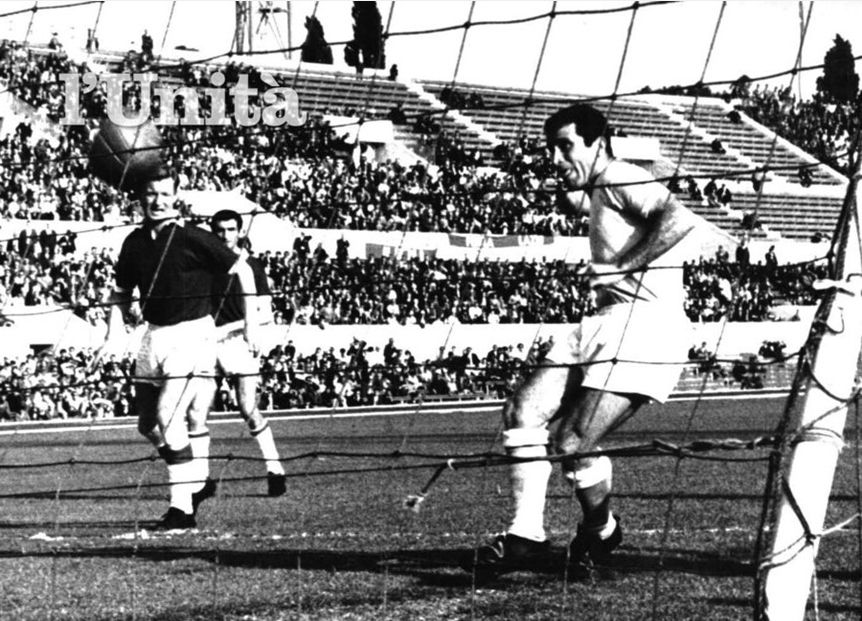
In the second half the two teams battled on a knife-edge of balance, but in the 58th minute the deadlock was finally broken. A corner was recovered on the flank by Masiello, who volleyed the ball back low into the centre for Morrone. From just a few metres out, he smashed a fierce rising shot past Zoff, who had no chance.
The Romans then dropped deeper, relying on counterattacks. In the 66th minute Pierluigi Pagni threw himself in the way of a powerful strike from the ever-dangerous Di Giacomo. Later, Enrico Burlando nearly doubled the lead at the end of a swift counterattack.
Mantova did not give up and continued to push for an equaliser. With only seconds remaining, Piero Scesa advanced and delivered a precise cross for Alberto Spelta, whose volley struck the outside of Cei’s net. The optical illusion momentarily froze the Biancocelesti supporters, who only after a few seconds burst into celebration and relief for the narrow escape and the precious two points secured.
In the relegation battle, with Lecco already down but defeating Brescia, Vicenza’s away win at Venezia — now almost doomed — was also noteworthy. With these two points, Lazio moved up to 25 alongside Brescia and S.P.A.L., while Vicenza sat fourth from bottom on 24 points and Foggia trailed on 20.
Who played for Lazio
Manager: Neri
Who played for Mantova
Zoff, Scesa, Pavinato, Volpi, Spanio, Giagnoni, Spelta, Catalano, Di Giacomo, Jonsson, Corelli
Manager: Cadè
Referee: Monti
Goal: 58’ Morrone
What happened next
With four games to the end, the Biancocelesti were 12th together with Spal and Brescia and one point ahead of Vicenza. Foggia, Venezia and Lecco were already doomed. Lazio played at home to Brescia knowing that a victory would probably get them out of the relegation battle. They lost as they did the next game at Bologna too. With two games to go, Brescia 28 points, Vicenza 27, Spal 26, Lazio 25.
In the last match at home the Biancocelesti managed to beat Foggia while Vicenza and Brescia lost and Spal drew. With one game to go, Spal, Vicenza and Lazio had 27 points and Brescia 28. Final games: Juventus-Lazio, Brescia-Cagliari, Vicenza-Bologna and Spal-Venezia.
At the end of the first half Vicenza and Lazio were both 0-0, Spal and Brescia were losing. There was still hope, but in the second half Lazio collapsed and Spal turned the game around. The Biancocelesti were relegated by one point.
The worst thing about this season were the 10 goalless draws. Which really showed that the attack in particular was greatly under par.
The players with most appearances were Carosi and Morrone (38), top scorer was Bagatti with 7 goals (4 in A).
Let’s talk about Maino Neri

Maino Neri was Lazio’s manager during the 1966-67 Season.
He was born in Carpi (Modena), on June 30, 1924. He grew up football-wise with nearby Modena. He made his debut in the 1940-41 season in Serie B. The "Canarini" were promoted to Serie A and the following year went straight down again but reached the semi-finals of Coppa Italia (Juventus 1-4). In 1942-43 the Gialloblu were promoted again in 1st place. In 1944 Modena won their regional group but then came 4th in the next regional stage.
The Second World War then interrupted all nationalfootball activities until the 1945-46 season. Modena finished 6th in the Alta Italia National Division and gained access to the following year's Serie A. In 1947 they came 3rd and in 1948 finished 5th. In 1949 however the "Geminiani" were relegated to Serie B. In the second tier in 1950 they finished 5th and in 1951 3rd. In all these years Neri played 265 games with 10 goals (4 in Serie A).
His positive performances earned him a move to Inter in the summer of 1951. At Inter in his first year he was coached by Aldo Olivieri and the Nerazzurri finished 3rd. Neri played 29 league games.
In 1952-53 former Lazio player Alfredo Foni became manager and Inter won the Scudetto. Neri played 26 league games.
In 1953-54 Foni stayed on and Inter became champions again. Neri played 32 league games.
In 1954-55, still under Foni, the "Beneamata" finished 8th. Neri played less, 21 league games. This was his last season with Inter.
In 1955-56 he joined Brescia in Serie B. He stayed three years with 80 league appearances and 1 goal. The "Leonessa" finished 7th, 3rd (lost the playoff to Alessandria) and 8th.
At 34 he retired in 1958.
Neri was a solid midfielder. He played 439 professional games (251 in Serie A and 108 for Inter). He was a respected and hardworking player, a "portatore di legna" as the Italians say (literally a wood carrier, a no frills player working for the good of the team). He was rewarded with two Scudetti with Inter and a promotion to Serie A with his beloved Modena.
He also earned 8 Italy caps and took part in the 1948 Olympic games and the 1954 World Cup.
In 1959 he returned to Inter to work in their youth sector and in 1960 he became assistant manager to Helenio Herrera with the first team. Neri stayed four years and Inter came 3rd, 2nd, 1st and 2nd while in 1964 they won the European Cup (Real Madrid 3-1 in Vienna).
After these years as assistant, in 1964 he went back to Modena as head coach in Serie B. He stayed two years finishing 7th and 13th.
In 1966 he moved to the capital and joined Lazio in Serie A. He took over from Umberto Mannocci who had led Lazio to 12th place the previous year. This year Mannocci started but was replaced by Neri on November 7, after 2 draws and 5 defeats (including the derby 0-1).
Neri's first game in charge was a 1-1 home draw with SPAL. In the end he was unsuccessful in avoiding relegation after 6 wins (including Inter 1-0), 13 draws (including derby 0-0) and 7 defeats, so an honourable record but not enough. Lazio's main problem, and not a minor one, was scoring goals, 20 all season in 34 games. Lazio's top scorers were Romano Bagatti and Juan Carlos Morrone with merely 4 league goals.
In 1967 he went back to Inter as assistant manager to Helenio Herrera again. He stayed two seasons with a 5th place under the "Mago" and a 4th place under former manager Alfredo Foni in 1968-69.
In 1969 he moved up to the lake and joined Como in Serie B as head coach. The "Lariani" finished 13th.
In 1971, after a year off, he went south and took charge of Reggina in Serie B. The "Reggini Calabresi" finished 16th.
In 1973, during the season, he replaced Giuseppe Corradi at Lecce in Serie C and finished 2nd, narrowly missing out on promotion.
This was his last managerial job, he then went to work for the Italian Football Federation at Coverciano.
At Lazio he was unlucky, taking over a team in difficulty, improving them but ultimately getting relegated through no fault of his own and then moving on. As a manager his biggest successes came as assistant to Herrera's Scudetto and European Cup winning Inter.
Maino Neri died in Modena on December 8, 1995.
Sources


Comments