
October 14, 1984: Lazio-Napoli 1-1

D’Amico and Maradona the Artists
D’Amico gives Lazio the lead, but Diego Maradona produces a moment of genius to rescue a point for Napoli at the Olimpico

The season so far
The previous season Lazio had avoided relegation by drawing 2-2 in the last game at Pisa. They had fought all season, changed manager from Giancarlo Morrone to Paolo Carosi, lost their star striker Bruno Giordano due to injury for many months, but in the end a Giordano double allowed Lazio to stay in Serie A.
“We will never suffer like this again”, said President Giorgio Chinaglia at the end of Pisa-Lazio.
But the club still had debts and it did not look like anybody in the US would come to the rescue. Chinaglia had a plan though. He was going to sell Giordano and Lionello Manfredonia, settle the debts and start building the club and team.
Giorgio in 1984 sold the Lazio golden boys to Juventus in exchange for money and a number of players. Giordano was going to be substituted by Massimo Briaschi who would be bought by Juventus from Genoa and given to Lazio. Once this deal was done, it was going to be Manfredonia’s turn.
First problem: Briaschi had no intention of coming to Lazio. Chinaglia offered him an amazing salary but he was not interested. Juventus would have offered Aldo Serena as a replacement but he also refused. Second problem: Juventus offered Giordano a lower wage compared to what he got at Lazio. Juve had a policy of low salaries but rich bonuses, but Giordano refused. At this point both deals failed and the two stayed in Rome. But this meant that all Chinaglia’s plans for a better team also collapsed. A few players were signed but they were not all that great: forward Oliviero Garlini (Cesena), defenders Massimo Storgato (Verona) and Arturo Vianello (Pisa) and midfielder Fortunato Torrisi (Catania). Ernesto Calisti returned from his loan to Cavese. Leaving Lazio were Angelo Cupini (Bari), Mauro Meluso (Cremonese), Mario Piga (Palermo), Rinaldo Piraccini (Pistoiese) and Massimo Piscedda (loan to Taranto).
The season started in August with the Coppa Italia. Lazio had not done too badly and were almost through to the second stage. The last game was against Roma. A point each would have meant that they would both go through but a ridiculous penalty given to Roma and an Antonio Di Carlo goal gave Roma the win. Lazio could still have got to the round of 16 anyway on goal difference as Genoa had to beat Pistoiese 5-0 to overtake Lazio. Unfortunately this is exactly what happened with three goals in the last eight minutes. The Biancocelesti were out and Chinaglia was furious. His temper did not improve after Lazio lost the first Serie A game against Fiorentina and most certainly not after losing 5-0 against Zico’s Udinese. He blamed Carosi for being too soft with the players and sacked him. Juan Carlos Lorenzo was called in his place.
Juan Carlos Lorenzo had been Lazio manager when Chinaglia joined in the 60s and he was very fond of him. In the first two games under his control, Lazio first drew at home with Inter and then away with Ascoli. But today they were faced with Diego Maradona’s Napoli.
The match: Sunday, October 14, 1984, Stadio Olimpico, Rome
There was something of an artistic quality to Lazio’s 1–1 draw with Napoli at the Olimpico. The two outstanding talents on the pitch, Vincenzo D’Amico and Diego Maradona, each produced a decisive piece of inspiration during the most vibrant spell of the afternoon, before the match gradually descended into a less purposeful exchange of possession.
For Lazio, however, the performance offered considerable encouragement. Under Juan Carlos Lorenzo, the team was beginning to look increasingly organised and purposeful, and there was a clear desire to play with greater confidence and attacking intent.
Lazio had the better of the opportunities and could reasonably feel that they had missed the chance to take both points. Yet they also had to contend with Maradona, whose individual brilliance was enough to overturn much of the good work done by Lorenzo’s side.
The opening half was particularly impressive.
Lazio defended intelligently, limiting Napoli's attacking options while paying special attention to Maradona. Young Francesco Fonte had been sent to Naples the previous week with Bob Lovati specifically to study the Argentine, and he performed his difficult task with considerable maturity.
He did not attempt to stop Maradona through force. Instead, he stayed close, reacted to his movements and tried to prevent him from finding the space in which to create. Maradona still produced moments of extraordinary skill, but Fonte ensured that they were not allowed to dominate the match.
At the other end, Lazio looked dangerous whenever they moved forward.
Their reward came in the 36th minute.
D'Amico received the ball and tried a shot which Luciano Castellini was unable to stop putting Lazio ahead, underlining the attacking confidence that Lorenzo was gradually restoring to the side. It was an authoritative strike and the culmination of a first half in which Lazio had generally looked the more convincing team.
The lead, however, lasted only until the second half.
Maradona eventually found his moment.
The Argentine produced a wonderfully crafted finish, described at the time as almost a Giotto-like painting, to bring Napoli level. It was precisely the kind of individual intervention that separated Maradona from almost everyone else on the pitch.
Lazio responded by continuing to look for a winner.
Michael Laudrup was one of their most effective players and would arguably have been even more dangerous had he been positioned further towards the centre. He created two excellent opportunities for Bruno Giordano, one shortly after the restart and another in the 63rd minute, but the Lazio striker failed to convert either.
Giordano, once renowned for his instinctive finishing, appeared unusually hesitant in front of goal.
Lazio continued to threaten. Joāo Batista and Lionello Manfredonia fought tirelessly, while Gabriele Podavini produced one of the game's most intelligent pieces of attacking play when he created an excellent opening in the 72nd minute. Unfortunately, his weaker left foot let him down when it mattered.
Napoli, meanwhile, had adjusted their midfield structure to compensate for the vulnerability of their defence. Salvatore Bagni, Paolo Dal Fiume, Luigi Caffarelli and Walter De Vecchi worked together across midfield, allowing the libero to step forward and give Napoli an extra man in the centre.
It helped them survive Lazio's pressure, although Castellini appeared increasingly troubled by the demands of the match. When he eventually left the field after suffering a heavy knock, it seemed to underline the physical limitations that were beginning to accompany the veteran defender.
The game also contained controversy surrounding referee Paolo Casarin.
Lazio coach Lorenzo and Laudrup were critical of several decisions, particularly the protection given to Maradona compared with the treatment received by Giordano and Laudrup. The most contentious incident came in the 42nd minute, when De Vecchi appeared to impede Laudrup as the Dane was racing through on goal.
Casarin was too far away to make the decision with complete confidence, and the incident remained open to interpretation.
Despite the frustration, there was a sense that this Lazio side was moving in the right direction.
The atmosphere at the Olimpico reflected that optimism. The stadium was well attended, with flowers and banners appearing before kick-off, while supporters celebrated a team that appeared to have rediscovered its appetite for winning. The sunny, almost spring-like conditions added to the positive mood.
And there was a significant improvement in the technical quality of Lazio's football.
In the end, though, the difference between a point and three was Lazio's inability to finish their chances.
There was a fitting final image to the afternoon. At the end of the match, Maradona and Batista exchanged shirts, bringing an end to an old controversy and providing a gesture of mutual respect between two of the game's great characters.
Who played for Lazio
Orsi, Storgato (78' Torrisi), Filisetti, Vianello, Batista, Podavini, D'Amico, Fonte (56' Calisti), Giordano, Laudrup, Manfredonia
Substitutes: Cacciatori, Spinozzi, G.Marini
Manager: Lorenzo
Who played for Napoli
Castellini (47' Di Fusco), Bruscolotti, Boldini, Celestini, Ferrario, De Vecchi, D.Bertoni, Bagni, Caffarelli, Maradona, Dal Fiume
Substitutes: G.De Rosa, Penzo, Carannante, Napolitano
Manager: Marchesi
Referee: Casarin
Goals: 35’ D’Amico, 51’ Maradona
What happened next
The beginning was comforting, a draw in the derby, a couple of wins, maybe Chinaglia was right after all.
After a 2-2 draw against Sampdoria, with Lazio 2-0 down but then scoring two goals in the last minutes of the game, the Biancocelesti lost seven consecutive games. Then, after a goalless draw at home against Ascoli, the Biancocelesti lost 4-0 against Napoli and that was the end of Lorenzo.
In came Giancarlo Oddi and Bob Lovati. Lazio were second from last, six points away from survival. A miracle was needed. After due draws, in the derby and against Atalanta, Lazio lost five consecutive games. One last moment of pride arrived in the last game at home against Juventus when, 3-1 down, they managed to equalise and almost win, hence showing that if they had continued with Carosi, the season would probably have been different.
Lazio were relegated despite having a team with Michael Laudrup, Bruno Giordano, Lionello Manfredonia, Joāo Batista and Vincenzo D’Amico.
Laudrup and Orsi were the players with most appearances (35), Giordano the top scorer with 8 goals.
Let’s talk about Diego Armando Maradona

Diego Armando Maradona was one of the greatest and most charismatic footballers in history, a player whose extraordinary talent transformed Napoli and carried Argentina to World Cup glory in 1986.
He was born in Lanús, Buenos Aires Province, on October 30, 1960. He grew up in Villa Fiorito, a poor district on the southern outskirts of Buenos Aires, in a large family. Football became an escape and an obsession from an early age. His extraordinary ability with a ball was apparent almost immediately.
As a child, Maradona became known as a gifted street footballer, developing the close control, balance and improvisational skills that would later become his trademark. His short stature and low centre of gravity allowed him to change direction at remarkable speed, while his extraordinary left foot gave him the ability to pass, dribble and shoot with equal precision.
At the age of eight he joined the youth system of Argentinos Juniors. He developed rapidly and was already being regarded as a phenomenon before he had reached his teens. In 1974, a group of children from the club known as Los Cebollitas, with Maradona as their outstanding player, went on an extraordinary unbeaten run that helped establish his reputation throughout Argentina.
Maradona made his first-team debut for Argentinos Juniors on October 20, 1976, ten days before his 16th birthday. He became the youngest player to appear in the Argentine top flight at the time.
Over the next five seasons he became the principal attraction of the club. Argentinos Juniors did not have the resources of Argentina's biggest teams, but Maradona turned them into a formidable side. He won the Argentine Primera División's top-scorer award in five consecutive seasons and scored 116 league goals in 166 appearances for the club.
Despite his extraordinary youth, Maradona was already considered a potential international star. He made his Argentina debut against Hungary in February 1977, aged only 16.
His greatest early international success came at the 1979 FIFA World Youth Championship in Japan. Maradona was the tournament's outstanding player and led Argentina to the title, winning the Golden Ball.
The tournament confirmed that Argentina possessed a player who could potentially become the successor to the generation that had won the 1978 World Cup.
Yet Maradona experienced his first major disappointment soon afterwards.
Argentina coach César Luis Menotti selected the squad for the 1978 World Cup on home soil without the 17-year-old Maradona, deciding that he was still too young. Maradona later recalled the disappointment of watching the tournament from home as Argentina won the World Cup.
It was a decision that would haunt him for only a few years.
In 1981 Maradona moved to Boca Juniors, one of Argentina's biggest and most passionately supported clubs. The transfer placed him under enormous pressure, but he responded almost immediately.
He helped Boca win the 1981 Metropolitano championship, his first major senior title. His performances attracted the attention of Europe's biggest clubs and, after the 1982 World Cup, Barcelona paid a then world-record fee to take him to Spain.
Maradona joined Barcelona in 1982 and arrived in Spain with the reputation of being perhaps the most exciting young player in world football.
His first season was interrupted by hepatitis, but he still demonstrated the qualities that had made him famous in Argentina. In his second season he appeared to be reaching his full potential before suffering a serious ankle injury in September 1983 after a brutal challenge from Athletic Bilbao's Andoni Goikoetxea.
The injury kept him out for several months.
Maradona returned to help Barcelona win the Copa del Rey and Spanish League Cup in 1983–84, but his relationship with the club became increasingly difficult.
Tensions with the board, opponents and sections of the Spanish football establishment culminated in the infamous confrontation during the 1984 Copa del Rey final against Athletic Bilbao.
After only two seasons in Barcelona, Maradona left Spain.
His next destination would define his legacy.
In the summer of 1984, Maradona moved to Napoli for a transfer fee of around £6.9 million, at the time a world-record fee.
The transfer was extraordinary because Napoli were not simply signing a brilliant footballer. They were placing the hopes of an entire city on his shoulders.
Napoli had never won the Italian championship. Serie A was dominated by the wealthy northern clubs, Juventus, Milan and Inter, while Napoli were regarded as outsiders. Maradona's arrival changed the balance of power.
More than 70,000 supporters reportedly attended his presentation at the Stadio San Paolo. The city had found its hero.
Maradona made his Serie A debut against Verona on September 16, 1984. The first season was difficult for Napoli, who finished eighth, but Maradona immediately demonstrated why he had been considered worth a world-record fee.
He was not simply a goalscorer. He operated primarily as a playmaker, often receiving the ball deep and carrying it forward himself.
His low centre of gravity made him extraordinarily difficult to dispossess. He could accelerate away from defenders, stop suddenly, change direction and deliver passes with either exceptional disguise or extraordinary accuracy.
He also possessed a powerful shot, a superb free kick and an instinct for creating something from situations in which other players could see no possibility.
Maradona's influence grew during the following seasons.
In 1986–87, Napoli finally achieved what had previously seemed impossible. They won their first Scudetto, with Maradona as the undisputed leader of the team. They also won the Coppa Italia, completing a domestic double.
The significance of the achievement went far beyond football. Napoli had broken the traditional northern dominance of Italian football, and Maradona became a symbol of the city's pride.
He was no longer simply a footballer. In Naples, he became an idol.
His relationship with the supporters was unusually intense. The city identified with his background, his defiance and his refusal to conform. His success was seen as the success of Naples itself.
At the same time, Maradona was preparing for the greatest international tournament of his career.
By the time of the 1986 World Cup in Mexico, Argentina coach Carlos Bilardo had built the team around him. Maradona was captain and was given extraordinary freedom to influence matches.
The system suited him perfectly.
Argentina's 3–5–2 structure provided protection behind him while allowing Maradona to operate between midfield and attack. Sergio Batista supplied control from midfield, Jorge Valdano offered a target in attack and Jorge Burruchaga provided movement and pace.
Maradona responded with arguably the greatest individual World Cup campaign ever produced by a player.
He scored five goals and provided five assists as Argentina won the tournament. He was awarded the Golden Ball as the competition's outstanding player.
The quarter-final against England became the defining match of his career.
Four years after the Falklands War, the political tension surrounding Argentina and England gave the match an extraordinary atmosphere. Maradona produced two completely contrasting goals.
His first came when he challenged Peter Shilton for a high ball and appeared to use his left hand to knock it into the net. The goal was allowed to stand and Maradona later famously described it as being scored "a little with the head of Maradona and a little with the hand of God."

Four minutes later came something entirely different.
Receiving the ball inside his own half, Maradona embarked on a spectacular solo run, beating a succession of English players before rounding Shilton and scoring. The goal became known as the Goal of the Century and is still regarded as one of the greatest individual goals ever scored.
Argentina won 2–1.
Maradona scored twice more in the semi-final against Belgium before Argentina defeated West Germany 3–2 in the final. He did not score in the final, but he supplied the decisive pass for Burruchaga's winning goal.
At 25, Maradona was a world champion.
Maradona returned to Napoli with his international reputation now enormous.
The club continued to build around him and in 1988–89 Napoli won the UEFA Cup, defeating Stuttgart in the final. It was the first major European trophy in the club's history.
The following season brought an even greater achievement.
Napoli won the 1989–90 Scudetto, their second Italian championship. Maradona had now led the club to the summit of Italian football twice, while also delivering the UEFA Cup, Coppa Italia and Supercoppa Italiana.
FIFA credits him with five major trophies during his Napoli career: two Scudetti, the Coppa Italia, the UEFA Cup and the Supercoppa Italiana.
The 1990 title was particularly significant because it came just before the World Cup that was staged in Italy.
Maradona arrived at the 1990 World Cup as both Argentina's captain and the most famous footballer in Italy.
The tournament was very different from Mexico four years earlier. Maradona was struggling with injuries and his movement was more limited, while Argentina adopted a much more defensive approach.
Nevertheless, he remained the team's central figure.
Argentina surprisingly lost their opening match to Cameroon and struggled through the group stage. They then defeated Brazil, Yugoslavia and Italy on penalties to reach the final.
The semi-final against Italy was particularly dramatic because it was played at Maradona's home stadium in Naples.
He appealed to Neapolitan supporters to support Argentina rather than Italy, arguing that Naples had often been treated differently from the rest of the country. The match ended 1–1 and Argentina won the penalty shoot-out.
The final in Rome ended differently. West Germany won 1–0 through Andreas Brehme's late penalty.
Maradona, exhausted and heavily marked throughout the tournament, left the pitch in tears.
Maradona's relationship with Napoli began to deteriorate after the 1990 World Cup.
He had become increasingly troubled away from the pitch and was struggling with cocaine addiction.
In March 1991 he tested positive for cocaine following a Serie A match and received a 15-month suspension.
His extraordinary relationship with Napoli had effectively come to an end.
He left Italy later that year, ending a seven-year period in which he had transformed both the club and the city.
After his suspension, Maradona joined Sevilla in Spain in 1992. He spent one season with the club before returning to Argentina with Newell's Old Boys. Sevilla even played Lazio in a friendly which ended 1-1.
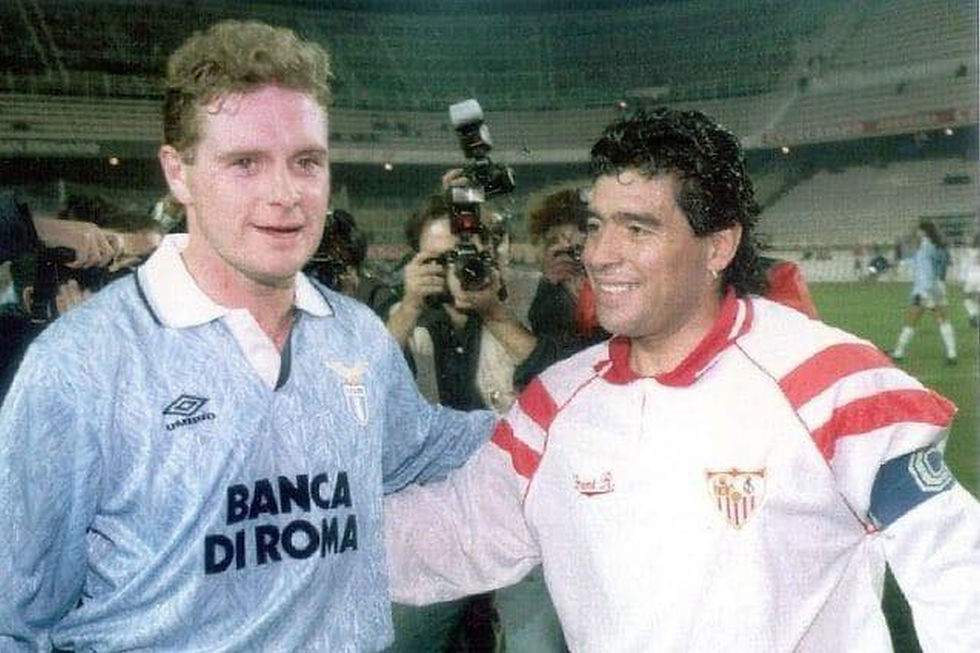
His final major chapter as a player came at Boca Juniors, where he returned in 1995.
Maradona played his final professional match on October 25, 1997, against River Plate. He retired from football shortly before his 37th birthday.
His playing career had taken him from the streets of Villa Fiorito to the biggest stadiums in the world. At club level he had represented Argentinos Juniors, Boca Juniors, Barcelona, Napoli, Sevilla and Newell's Old Boys, returning to Boca for a second spell.
Maradona's international career ended at the 1994 World Cup in the United States.
At 33, he was no longer the player who had dominated Mexico eight years earlier, but he remained capable of producing moments of brilliance. He scored against Greece before playing against Nigeria.
After the Nigeria match, however, Maradona was removed from the tournament after testing positive for the banned substance ephedrine.
It was a deeply disappointing end to his World Cup career.
In total, he represented Argentina at four World Cups: Spain 1982, Mexico 1986, Italy 1990 and USA 1994. He played 21 World Cup matches, scoring eight goals.
After retiring as a player, Maradona's life remained turbulent.
He worked as a television personality and later moved into coaching. His managerial career included spells with clubs in Argentina, the United Arab Emirates and Mexico.
In 2008 he was appointed coach of the Argentina national team. He led them to the 2010 World Cup in South Africa, where Argentina were eliminated by Germany in the quarter-finals.
His later years were marked by continuing health problems, weight fluctuations and struggles related to his long-term addictions. Yet his popularity never disappeared.
In Argentina, and particularly in Naples, Maradona remained an almost untouchable figure.
Diego Maradona died on November 25, 2020, at the age of 60, after suffering a cardiac arrest. His death provoked an extraordinary outpouring of grief in Argentina, Naples and throughout the football world.
His legacy is complicated.
There was the footballer: perhaps the most naturally gifted player of his generation, capable of controlling matches through dribbling, passing, movement and improvisation. There was the champion who won the World Cup and transformed Napoli into Italian champions. And there was the deeply flawed human being whose addictions and personal problems repeatedly threatened to overwhelm his career.
Trying to separate one from the other is almost impossible.
Maradona's genius was partly rooted in his instinctive, street-football style. He played with an extraordinary mixture of imagination and aggression. He could see passes before anyone else, manipulate the ball at impossible angles and carry it through several defenders while seemingly keeping it attached to his left foot.
But his importance went beyond statistics.
He gave Napoli something the club had never possessed: the belief that it could defeat the most powerful teams in Italy. He gave Argentina one of the greatest World Cup performances ever witnessed. And he became a symbol of a city, a country and a generation.
Few footballers have ever carried such expectations.
Fewer still have fulfilled them.
Maradona did.
And for all the controversy that surrounded his life, the image that remains strongest is still that of the small, stocky number 10, the ball seemingly glued to his left foot, accelerating towards another defender who already knew that he was probably too late.
Sources


Comments