
October 15, 1939: Milano-Lazio 0-2

Pisa and Piola conquer San Siro
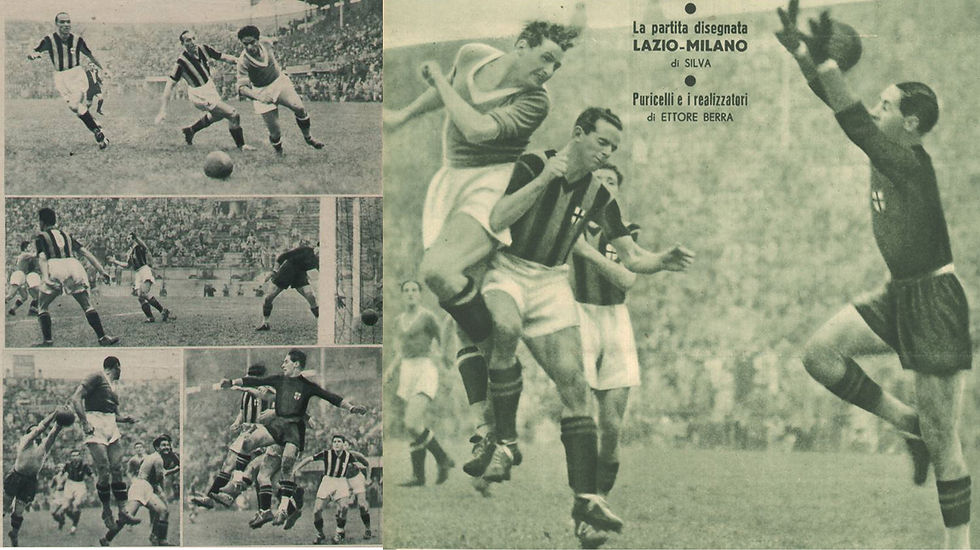
Two early second half goals give Lazio good win at "La Scala"
Also on this day:
The season so far
The previous season Lazio had finished 10th, first under Hungarian József Violak (Italianised to Viola) and then from the 20th game onwards under player-manager Luigi Allemandi.
This season Lazio had another Hungarian manager Géza Kertész. Lazio could not invest much over the summer due to the usual financial difficulties. Three Argentinians had arrived months earlier in February but now finally had the right documentation to be put on the Lazio books: midfielder Enrique Flamini (Racing Club), forwards Evaristo Barrera (Racing Club) and Silvestro Pisa I (Independiente). So, the three "oriundi" were Lazio's reinforcements. Oriundi were foreign players with Italian origins who could even represent Italy.
The main players leaving Lazio were defender Benedicto Zacconi (retiring), midfielder Giovanni Riccardi (Liguria) and forward Emilio Capri (Torino).
Lazio had started the season well. After 4 matches the Biancocelesti were 2nd (with Inter) on 6 points. Lazio had won the last 2 (Fiorentina 3-2 away and Genova 1893 4-1 at home) after drawing the first 2 (Modena 1-1 away on debut and Torino 1-1 at home). Silvestro Pisa had scored three goals and Silvio Piola two.
Milano (AC Milan Italianised by the regime) had finished 9th the previous season. The manager was Hungarian József Bánás and top scorer Aldo Boffi with 21 goals (19 in A). The Rossoneri had beaten Lazio 3-0 at home and drawn 2-2 in Rome.
This season the manager was still Bánás, with compatriot and former Lazio József Violak as technical director. The main new signings were: goalkeeper Egidio Micheloni (Verona), defender Enrico Boniforti (Varese), midfielders Bruno Chizzo (Triestina) and Piero Pasinati (Triestina) plus forward Carlo Biraghi (Pro Vercelli).
Leaving the Rossoneri were: defenders Mario Provaglio (Pisa), Sereno Gianesello (Venezia), midfielder Egidio Capra (Lucchese) plus forward Giovanni Moretti (after 223 games and 68 goals, to Brescia).
So far Milano had won 2 (Fiorentina 3-1 and Bari 4-0 at home), drawn 1 (Genova 1893 1-1 away) and lost 1 (Torino 1-2 away on debut). The Rossoneri were 4th on 5 points (with Torino, Roma and Bologna).
A big match today between two sides in the higher part of the table.
The match: Sunday, October 15, 1939, Stadio San Siro, Milan
A cloudy day in Milan and the pitch was slightly muddy. A crowd of about 25,000 turned up at San Siro.
Milan had the whole squad available. The two future Lazio players, Leandro Remondini and Paolo Todeschini were not in the starting line-up.
Lazio too had a full-strength team.
Lazio started the game with authority and were the more dangerous.
In the 13th minute a good combination between Enrique Flamini and Luigi Vettraino set up Silvio Piola but Mario Zorzan saved well.
In the 19th minute Lazio had a free kick taken by Giuseppe Baldo, the ball entered the area and was missed by Bruno Berra thus reaching Vettraino whose shot was superbly stopped by Zorzan. On the rebound Pisa shot again but this time defender Giuseppe Bonizzoni headed away for a corner.
In the 21st minute Milano showed themselves up front but Ezio Loik's mid-height effort was comfortably caught by Giacomo Blason.
It was still Lazio though who were more threatening in the 26th and 28th minutes but Zorzan was safe and there was even a suspect defender's handball but the referee saw nothing.
Lazio were pushing hard but in the 32nd minute it was Milano who had a huge chance. Piero Pasinati found himself in a goalscoring position but Blason pulled off an excellent save.
A minute later Vettraino was a fraction of a second late to head in a good cross by Umberto Busani.
Halftime came with the game still goalless but far from boring.
In the second half Lazio came out stronger, pinning Milano back. In the 51st minute the Biancocelesti took the lead. A venomous cross by Luigi Milano was slapped away by Zorzan and while Vettraino and defender Bonizzoli were battling for the ball in came Pisa who blasted it past Zorzan, 0-1.
Lazio were rampant and in the 56th minute Piola's header shaved the post from a Busani cross.
A minute later Lazio perfectioned the move. Busani crossed again and Piola, despite being challenged by two defenders, with perfect timing headed the ball in, 0-2. Even the home Milano supporters applauded the quality of the goal.
Lazio insisted and in the 63rd minute Piola let off a spectacular volley which went millimetres wide of the post.
At this point Milano had a reaction and pushed forward. They were not lucky however and hit the woodwork twice. First a Pasinati corner hit the inside of the post and then a blistering long range shot by Aldo Boffi came back off the crossbar.
Lazio survived the Rossoneri's comeback attempt and then had more chances to make it three.
In the 79th minute Piola glided past two defenders and sent a cracking shot towards goal which only a superb reflex save by Zorzan kept out.
In the 85th minute Piola had only the keeper to beat but lost his balance on the slippery grass.
In the last minute a Pisa cannonball whistled past the post. Final score Milano 0 Lazio 2.
A brilliant performance by the Romans and a well deserved win. An entertaining and fast paced game had seen Lazio as the undisputed better team. The whole Lazio eleven had played well with a special mention for tireless assist man Busani.
Lazio were now joint top with Venezia on 8 points (the Venetians had drawn 2-2 at Modena while Inter had lost 0-3 at Bari).
Milan were 7th on 5 points, with Torino, Juventus, Bologna and Bari.
Who played for Milan
Zorzan, Berra, Bonizzoni, Antonini, Bortoletti, Villa, Pasinati, Chizzo, Boffi, Loik, Biraghi
Manager: Bánás
TD: Violak
Who played for Lazio
Manager: Kertész
Referee: Scarpi
Goals: 50’ Pisa, 55’ Piola
What happened next
Lazio had a good season and finished 4th. In the next 25 games they won 9 (including Juventus 4-0 at home), drew 9 (including Milan 2-2) and lost 7. The highlight was defeating Roma 1-0, on the 26th May…. with an Enrique Flamini goal. The top scorer was Piola with 10 goals (9 in A) while Pisa also got 9 league goals.
In Coppa Italia Lazio beat Triestina 2-1 away, then Macerata 2-0 at home in the last 16 but then lost to Fiorentina 1-4 away in the quarterfinals.
A positive season for the Aquilotti.
Milano finished 8th. The Diavolo then won 8 (including derby 3-0), drew 7 and lost 10 (including second derby 1-3). The top scorer was Boffi again with 24 league goals (also Serie A top scorer).
In the Coppa Italia, Milan beat Novara 2-0 away but in the last 16 lost 0-5 away to Fiorentina in a replay (1-1 a.e.t at San Siro).
The Serie A champions were Inter for the 5th time. Liguria and Modena were the unlucky ones descending to Serie B.
Lets talk about The San Siro

The San Siro, now also called the Giuseppe Meazza, is an iconic stadium. In Italy they call it "La Scala del Calcio". It is situated in the San Siro area of north-west Milan which also hosts a famous horse racing course. The area takes its name from the old church of San Siro alla Vepra.
It was inaugurated in 1926 and was in "English style". The Milan president at the time was Piero Pirelli and the project of building the stadium was given to Ulisse Stacchini (who had already built the Milan Central Station) and Alberto Cugini.
It had four independent stands and a cover over the grandstand. For the times it was extremely modern. It has since been renovated four times; 1937-39, 1954-55, 1987-90 and 2015-16.
When it opened, only Milan played there. The other Milanese club Inter joined them in 1947.
In 1935 it was bought by the Milan council and two years later underwent its first expansion.
In the mid 1950's the "secondo anello" (second tier) was added and the capacity reached almost 100,000. In 1957 the floodlights were added.

In 1967 the first mega scoreboard was installed.
In 1980 it officially became known as the Giuseppe Meazza stadium. The former Inter and Milan player, who also won two World Cups, died on August 21, 1979.
For Italy '90 World Cup the "terzo anello" and the roof was built although the capacity by now was about 83,000. The roof would cause problems with the growth of the grass for many years to come. In 2012 these problems were finally solved with the help of a percentage of modern synthetic grass and a technological change in the atmospheric conditions inside the ground itself.
The most recent changes were minor and involved the modernisation of the inside of the structure plus the pitch and the dugout area. The capacity is now 76,000, all seating.
The first big international game took place in 1934 when it hosted one of the World Cup semi-finals. In 1980 it saw matches of the European Championship and in 1990 some World Cup games (including the opener). Four European Cup/Champions League finals have been played there and four UEFA Cup finals (due to the host team, Inter 3 times and strangely Juventus once). In 2019-20 Atalanta played their Champions League games there. More recently the Final Four of the Nations League was organised there.
It was built as and is a football stadium but has also been used for big Rugby games, for example Italy versus All Blacks in 2009 when 81,000 spectators attended. In 1960 it also held an important boxing match between Italian Duilio Loi and Puerto Rican Carlos Ortiz. In 2026 it will be used for the opening ceremony of the XXV Olympic Winter Games of Cortina d'Ampezzo.
The stadium has also regularly been used, especially in the summer, for big music concerts. Popular Italian artists such as Vasco Rossi and Ligabue plus international stars including Bob Marley, Michael Jackson, Bob Dylan, Bruce Springsteen, Pearl Jam, U2 and the Rolling Stones have all performed there.
On 30 September 2025, Milan’s City Council approved the sale of the San Siro real estate complex (“GFU San Siro”), which includes the Giuseppe Meazza stadium, to AC Milan and Inter. The amount of the sale is approximately €197 million and the clubs have submitted a joint feasibility plan for building a new stadium & redeveloping the surrounding area.
The Milanese ground is one of the most iconic stadiums in Europe for its size and unique shape and structure. For locals it has been voted the second most important symbol of the town after the Duomo. For football the fact that it has no athletics track (unlike Rome, Naples and many others) has led it to be considered the ideal stadium to enjoy matches. La Scala del Calcio has seen some epic games and witnessed the eternal rivalry between two of Italy's most important clubs, A.C Milan and Internazionale.
It will be sad when it goes.
Sources


Comments