
September 30, 1934: Lazio Livorno 6-1

From Doubt to Destruction
Lazio overcome a sluggish first half to tear Livorno apart after the interval, scoring four unanswered goals to turn a precarious afternoon into a 6–1 triumph

The season so far
The previous year Lazio had arrived tenth. The club’s main objective had been to have a comfortable year and to avoid relegation, so in the end mission accomplished.
For the 1934-35 season the club was more ambitious. The Biancocelesti had signed a promising centre forward from Pro Vercelli, Silvio Piola, another forward Felice Levratto plus midfielder Giuseppe Viani from Ambrosiana Inter, goalkeeper Giacomo Blason from Triestina and the World Champion Attilio Ferraris IV. Leaving Lazio were Pietro Buscaglia (Torino), Bruno Bedosti (Anconitana), Duilio Salatin and Pepe (Brazil), Giovanni Battioni and Augusto Mattei (Aquila), Mario Tonali (Pisa) and Raggio Montanari (Foggia).
Today was the first match of the season.
The match: Sunday, September 30, 1934, Stadio PNF, Rome

The final score suggested an afternoon of complete Lazio domination. The reality, at least for the first 45 minutes, was very different.
On 30 September 1934, an enormous crowd packed the Stadio PNF to watch Lazio take on Livorno, with the home club's cashier presumably delighted by the attendance. Yet by half-time there was little to suggest that the Biancocelesti would eventually record one of the most emphatic victories of the opening weeks of the championship.
At the interval, Lazio led only 2–1, and even that advantage had been achieved with considerable difficulty. Livorno had spent much of the first half looking the more organised and purposeful side, while Lazio struggled to match their opponents for precision, speed and determination.
The opening goal, however, was beautifully constructed.
After 11 minutes, Silvio Piola released Anfilogino Guarisi, who returned the ball to the Vercellese forward. Wando Persia attempted to clear, but the ball struck the knee of the arriving Antonio Bisigato and ricocheted into the net.
Lazio were ahead, but Livorno were not intimidated.
Their response was led by the extraordinary Ulisse Uslenghi, who was proving almost impossible to contain. After a series of dazzling touches, he burst towards goal and managed to squeeze the ball underneath the crossbar. It struck one post, then the other, before finally crossing the line.
There was no doubt about the equaliser.
Three minutes later, however, Guarisi restored Lazio's advantage. Having dribbled past the final defender, the Lazio forward was about to shoot when Uslenghi brought him down with a perfectly clear foul. The referee, Cimberlini, awarded a penalty and Guarisi calmly converted.
Lazio led, but Livorno had arguably been the better team.
Uslenghi was controlling the midfield, while Alfredo Monza and Giovanni Busoni provided Livorno with an effective attacking threat. At the other end, mario Magnozzi and Nicola Ferrara were equally impressive. The visitors repeatedly exposed weaknesses in the Lazio defence.
There were several warnings.
In the 26th minute, Giacomo Blason was beaten by a shot from Coriolano Pontiggia, only for Armando Del Debbio to perform a miraculous headed clearance on the goal line, preventing Busoni from turning the rebound into an equaliser. Blason himself then produced a superb diving save.
The physical intensity was also increasing. A collision involving Armando Bertagni, Attilio Ferraris IV and Busoni left the two Italian internationals on the ground with blood streaming from their faces. Ferraris and Bertagni would continue, but both were heavily bandaged.
At half-time, Lazio had plenty to think about.
The Biancocelesti had struggled badly against a Livorno side that had defended in numbers while somehow also controlling the match. The question was whether Lazio's celebrated attacking line could finally justify its reputation as a “goal machine.”
The answer came almost immediately after the restart.
Something had changed.
Lazio emerged with greater aggression and determination, while Livorno's defensive organisation began to unravel. The visitors were visibly tiring, and Lazio began to impose the superior athleticism and attacking quality that had been missing during the opening 45 minutes.
Eight minutes into the second half, Virgilio Levratto’s ferocious shot crashed against the post.
Two minutes later, Paolo Lami was forced into a difficult save. Then, after a dangerous Livorno attack, Octavio Fantoni II intervened at the last possible moment to dispossess Pontiggia, who had escaped what appeared to be an offside position.
Lazio were now taking control.
Piola soon released Levratto, who found himself only a few metres from goal. Lami somehow managed to keep out his effort.
But Livorno could not survive indefinitely.
Two minutes later, Piola completed the move that had begun with his own intervention, linking with Joao Fantoni I and Guarisi before finishing the attack himself.
3–1.
The match was transformed.
Lazio suddenly played with the confidence that had been absent before the interval. Giuseppe Viani became increasingly influential in midfield, dictating the tempo and helping to suffocate Livorno's most dangerous player, Uslenghi. The visitors, meanwhile, appeared to be running out of energy.
For roughly a quarter of an hour, Livorno were effectively pinned back.
Piola continued to threaten, Guarisi was increasingly dangerous, and the two Fantonis repeatedly found space. Levratto, whose power had already troubled Lami, remained a constant menace.
In the 30th minute came the fourth.
Levratto carried the ball forward before feeding Piola. The centre-forward suddenly shifted the ball towards the right, where Fantoni I met it perfectly and sent his shot beyond Lami.
4–1.
The resistance was over.
Five minutes later, another sweeping Lazio attack produced a fifth. Guarisi delayed his pass before finding Fantoni I, who completed his personal contribution to a remarkable second-half performance.
5–1.
What had looked like a difficult contest at half-time had become a rout.
And Lazio were not finished.
The final goal originated with Viani, who launched a long ball towards Piola. The centre-forward moved out towards the right, reached the byline and sent a cross back into the area. Guarisi had anticipated the move and arrived at speed to finish the attack.
6–1.
The transformation was extraordinary. Livorno had spent the opening period exploiting Lazio's weaknesses; after the interval, those same weaknesses appeared to have migrated to the other end of the pitch. The visitors could no longer contain the movement of Piola,
Guarisi, the Fantonis and Levratto, while Viani increasingly controlled the game from midfield.
For Lazio, it was a victory that said as much about character as attacking quality.
Who played for Lazio
Blason, Bertagni, Del Debbio, Ferraris IV, Viani, Fantoni II, Guarisi, Fantoni I, Piola, Bisigato, Levratto Manager: Alt
Who played for Livorno
Lami, Persia, Monza II, Arcari II, Uslenghi, Garraffa, Neri, Ferrara, Busoni, Magnozzi, Pontiggia Manager: Hansel
Referee: Ciamberlini
Goals: 18' Bisigato, 34' Uslenghi, 37' Guarisi (pen), 64' Piola, 74' Fantoni I, 79' Guarisi, 81' Guarisi
What happened next
At the end of the first half of the season Lazio were sixth. Unfortunately, the year would be characterised by the death of Ottavio Fantoni II, cousin of Joao Fantoni I. During the game against Torino on January 20 he injured his nose. It seemed nothing particularly serious but the injury caused an infection. After two weeks of great suffering, Fantoni II died.
Lazio had an excellent attack but not such a good defence. There were some heavy defeats (6-1 against Juventus away but also 4-1 and 5-3 at home against Milan and Fiorentina). However, the wins against Juventus, Napoli and Inter at home had shown that Lazio could compete with the stronger clubs. Lazio also beat Pro Vercelli 6-0. The Biancocelesti finished 5th.
Ferraris IV was the player with most appearances (30), Piola with the most goals (21)
Lazio Jersey 1934-35
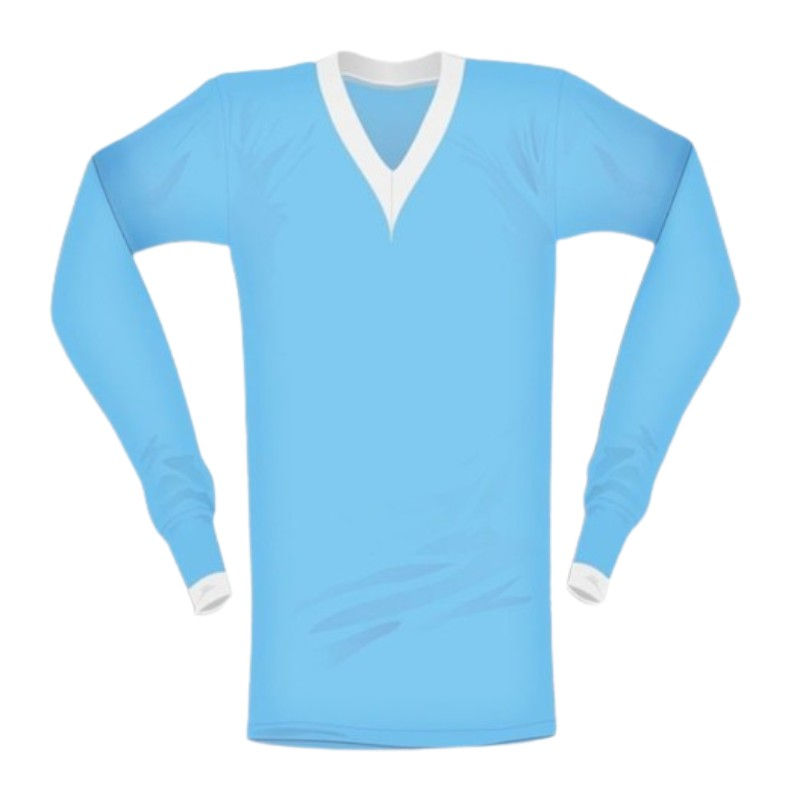
The 1934–35 season marked an important turning point in the history of Lazio. On the pitch, the club was assembling one of the most ambitious teams of its early history. Off it, Lazio were entering a new era under President Eugenio Gualdi. And on the players' backs was a shirt that seemed to look deliberately towards the club's past.
After several seasons in which Lazio's jerseys had experimented with different details and designs, the 1934–35 shirt returned to a more traditional appearance. It was, according to the S.S. Lazio Museum, perhaps the design that most faithfully reflected the traditions of the first football club of the capital.
The shirt was a classic sky blue, the colour that had become inseparable from Lazio's identity. Its close-fitting cut reflected the football clothing of the period, when jerseys were considerably heavier and less forgiving than the modern shirts familiar today. What immediately distinguished the design was the large white V-neck collar, complemented by matching white cuffs.
There was little need for ornamentation. The combination of sky blue, white collar and white cuffs created a simple and unmistakable Lazio appearance – a shirt rooted in the club's earliest traditions at a moment when the team itself was beginning to acquire a very different stature.
It was a classic Lazio jersey for a season in which the club itself was beginning to become something new.
The white V-neck and cuffs, set against that unmistakable celeste cielo, gave the team a distinctive appearance that connected the ambitious Lazio of the mid-1930s with the club founded more than three decades earlier.
In that sense, the 1934–35 shirt was more than simply a football jersey. It was a visual bridge between Lazio's traditions and its ambitions – a familiar symbol worn by a team that was beginning to dream on a much larger scale.
Sources


Comments