
September 24, 1989: Verona Lazio 1-1

A Draw Nobody Wanted
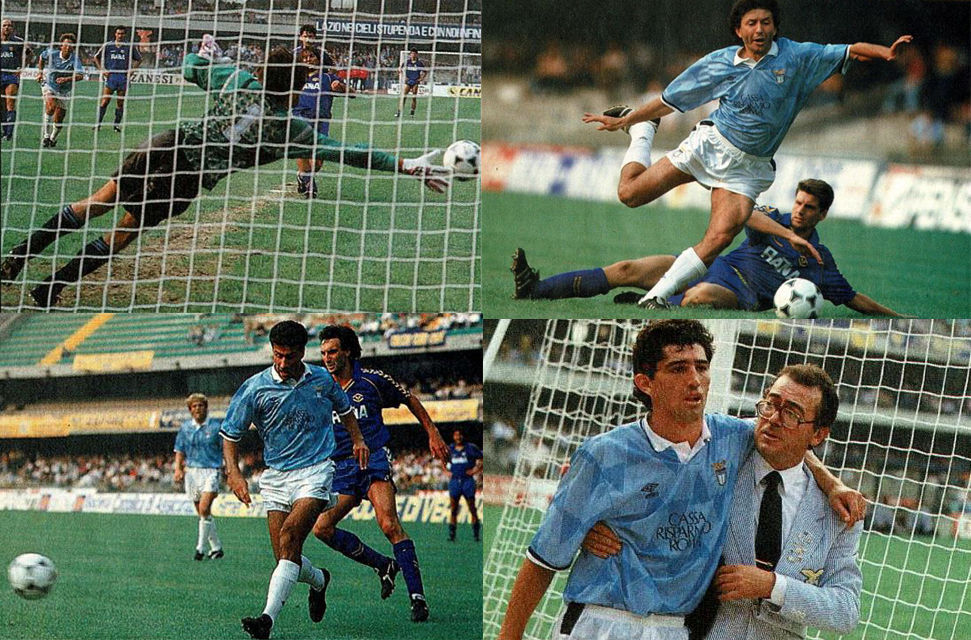
Lazio escape from a dreadful afternoon at the Bentegodi as Sergio’s cross takes a decisive deflection to rescue a point against Verona
The season so far
The previous season Lazio had struggled and were only able to avoid relegation in the final game of Serie A.
The summer transfer window of 1989 saw the sale of the players that had been chosen by Eugenio Fascetti the previous year, just before his shock firing from Lazio. Manager Giuseppe Materazzi was therefore able to choose his own players, or at least propose them.
So in came Pedro Troglio, Amarildo, Roberto Soldà, Raffaele Sergio and the return of Nando Orsi and out went Gustavo Dezotti, Nelson Gutierrez, Silvano Martina, Ciro Muro, Raimondo Marino and Antonio Acerbis.
Lazio were forced to play in the small Flaminio stadium because the Olimpico was undergoing a heavy restructuring for the 1990 World Cup.
The Biancocelesti had played five games so far winning two, an incredible win in Milan and a 3-0 against Lecce, drawn 1, lost two, and were ninth.
The match: Sunday, September 24, 1989, Stadio Marc’Antonio Bentegodi, Verona
There were 6,376 paying spectators at the Bentegodi on 24 September 1989, and together they paid more than 102 million lire to watch Verona and Lazio. By the final whistle, there must have been more than a few wondering whether they should have been entitled to a refund.
The applause was largely replaced by relief when referee Fabio Baldas brought an end to one of the dreariest matches either side would play that season. There had been more yawns than whistles, more mistakes than moments of quality and, for long periods, very little to suggest that this was a Serie A encounter.
For Lazio, the contrast with the previous weekend was particularly striking. Seven days earlier, Giuseppe Materazzi's side had swept aside Lecce in an impressive display. At Verona, however, the Biancocelesti looked almost unrecognisable: passive, hesitant and short of ideas.
The absence of Rubén Sosa was a significant blow. Without the Uruguayan's pace and creativity, Lazio appeared to lack the player capable of turning possession into danger. Verona, themselves struggling badly after their great Scudetto-winning years, sensed an opportunity.
The opening half-hour belonged to the home side, even if calling it dominance would be generous. Verona were hardly convincing, but Lazio's apathy made them look considerably better than they actually were. Maurizio Iorio and Davide Pellegrini repeatedly found space, while Pietro Fanna's movement from midfield gave the hosts an additional attacking outlet.
Osvaldo Bagnoli had made an intriguing tactical adjustment, moving Fanna deeper and allowing Raffaele Sergio to operate further forward. The change helped Verona exploit the spaces in front of the Lazio defence, and the visitors spent much of the opening period looking strangely disjointed.
Eventually, Verona found their reward.
After 37 minutes, Pellegrini went down following a challenge from Claudio Sclosa and Baldas pointed to the penalty spot. A harsh decision. Iorio stepped forward and sent the ball beyond Valerio Fiori to give Verona a 1–0 lead.
For a brief period, the home side looked capable of taking control. Verona came close to exploiting Lazio's uncertainty again, but the opportunity to deliver the decisive blow passed them by. Iorio and Pellegrini worked tirelessly, yet the team lacked the quality to turn pressure into a second goal.
Lazio survived.
Materazzi made his first change at half-time, withdrawing Paolo Di Canio, who had spent the previous night unable to sleep after undergoing intensive treatment for toothache. Franco Marchegiani replaced him for the second half.
Lazio needed something to change. Instead, Verona changed the scoreline for them.
On 55 minutes, Sergio burst forward down the left and attempted to send a cross towards the centre. The ball took a decisive deflection off Gustavo Sotomayor and flew past substitute goalkeeper Gianfranco Bodini, who had replaced the injured Angelo Peruzzi. An unfortunate own goal had brought Lazio level.
It was scarcely a goal Lazio had created, but they were not about to complain.
The equaliser changed the complexion of the match. Verona lost what little confidence they had possessed, while Lazio became increasingly concerned with protecting the point. The visitors withdrew into a compact defensive shape around Fiori and concentrated on preventing Verona from finding the winner.
The spectacle deteriorated further.
The final quarter of an hour offered almost nothing in the way of attacking football. Verona lacked the imagination to break down Lazio's defensive wall, while the Biancocelesti appeared more than satisfied to leave the Bentegodi with a point.
Then, in the 87th minute, came the strangest episode of the afternoon.
Amarildo went down after a challenge and appeared to have injured his right ankle. The Lazio bench called for his replacement, with Marco Monti ready to come on. Amarildo pulled down his sock to inspect the injury and began making his way towards the touchline, limping visibly.
Baldas, however, believed the Brazilian was taking too long to leave the pitch and showed him a yellow card.
Amarildo responded by applauding the referee.
Baldas immediately produced a second yellow and sent him off.
It was a remarkable ending to an already miserable afternoon. Amarildo walked away in tears, while Lazio were forced to finish the match with ten men.
There was little time left for Verona to take advantage.
The final whistle eventually arrived as something of a mercy. Lazio had escaped with a 1–1 draw, but there was little satisfaction in the point. Verona had been poor; Lazio had been scarcely better. The two sides had managed to share the goals, the mistakes and, most importantly, the boredom.
Who played for Verona
Peruzzi (49' Bodini), Favero, Pusceddu (69' Gritti), Terracciano, Bertozzi, Sotomayor, Fanna, Acerbis, Iorio, Magrin, Pellegrini
Substitutes: Piubelli, Pagani, Mazzeo
Manager: Bagnoli
Who played for Lazio
Fiori, Bergodi, Sergio, G.Pin, Gregucci, Soldà, Di Canio (46' F.Marchegiani), Icardi, Amarildo, Sclosa, Bertoni
Manager: Materazzi
Referee: Baldas
Goals: 37' Iorio (pen), 55' Sotomayor (og)
What happened next
Lazio played with dignity, but lacking the spark that could ignite hopes and fans. There were so many goalless draws (7!!!) that Materazzi started being called Mr. 0-0. And it was a shame because Lazio ended up just three points behind Bologna who, due to Milan winning the European Cup and Sampdoria winning the Cup Winners Cup, were able to qualify for the 1990-91 UEFA Cup. A real missed opportunity that cost Materazzi his job at the end of the season.
Soldà was the player with most appearances (33 in Serie A and 2 in Coppa Italia) whereas the top goal scorer was Amarildo with 9 goals (8 in Serie A and one in Coppa Italia).
What happened in Serie A 1989-90

The previous season the Scudetto had been won by Inter. It was a record-breaking campaign for the Nerazzurri. After the first half of the fixtures, Inter had a single-point advantage over Napoli and five points over Sampdoria, but then pulled away and reached a nine-point lead with four games to go. Napoli finished second and Milan third.
In the summer transfer window, champions Inter signed Jürgen Klinsmann, while Napoli changed manager as Ottavio Bianchi left for Roma. His replacement was Alberto Bigon. Other interesting signings included Gigi Casiraghi and Totò Schillaci at Juventus, Gianfranco Zola at Napoli, and Bruno Giordano and Antonio Cabrini at Bologna.
Inter were obviously among the favourites, but Napoli and Milan were expected to provide strong opposition.
August & September
Roma and Napoli started well and raced to the top, followed by Juventus and Inter. Milan surprisingly lost at home to Lazio, while Sampdoria beat Inter at home before the Nerazzurri responded with victory over Juventus.
In the European Cup, Inter were unexpectedly eliminated by Malmö, drawing 1–1 at home after a 1–0 defeat in Sweden. Milan, meanwhile, defeated HJK Helsinki 5–0 on aggregate. In the Cup Winners' Cup, Sampdoria eliminated Brann 3–0 on aggregate. In the UEFA Cup, Fiorentina eliminated Atlético Madrid after a 1–1 aggregate draw and a penalty shoot-out, while Napoli also required penalties after two 0–0 draws with Sporting. Atalanta were eliminated by Spartak Moscow 2–0 on aggregate, while Juventus eliminated Górnik Zabrze 5–2.
There was a strange formula for the Coppa Italia that season. Two preliminary rounds reduced the field to 12 teams, which were then divided into four groups of three. The group winners qualified for the semi-finals. Roma, Napoli, Milan and Juventus eventually reached the last four.
Roma 10, Napoli 10, Juventus 9, Inter 9, Milan 8, Sampdoria 8, Bologna 8, Lazio 6, Genoa 6, Lecce 6, Fiorentina 5, Atalanta 4, Bari 4, Ascoli 4, Cesena 4, Udinese 3, Cremonese 2, Verona 2
October
Napoli crushed Milan 3–0 in the seventh fixture, while Roma lost 3–0 to Inter, allowing Napoli to take the solitary lead.
The big clash in the second round of the European Cup, and perhaps rather early in the competition, was between Milan and Real Madrid. The Rossoneri won the first leg at home 2–0 and, despite losing 1–0 in Madrid, progressed 2–1 on aggregate. Sampdoria, in the Cup Winners' Cup, drew 1–1 away to Borussia Dortmund. In the UEFA Cup, Juventus eliminated Paris Saint-Germain, Fiorentina eliminated Sochaux on the away-goals rule, and Napoli beat Wettingen 2–1 on aggregate.
Napoli 16, Juventus 14, Inter 14, Roma 13, Sampdoria 12, Bologna 11, Atalanta 11, Lazio 10, Milan 10, Lecce 10, Fiorentina 9, Bari 9, Genoa 9, Ascoli 8, Udinese 8, Cremonese 6, Cesena 6, Verona 4
November
Milan beat Juventus 3–2 in the 11th fixture and then won the derby 3–0. Juventus had the chance to reduce the gap with Napoli in the 13th round, but the match finished 1–1, just like the Rome derby. Verona and Ascoli were already in difficulty at the bottom of the table.
In the European Cup, Milan lost 1–0 in Madrid but progressed 2–1 on aggregate thanks to their home victory. Sampdoria also qualified for the Cup Winners' Cup quarter-finals, eliminating Borussia Dortmund 3–1 on aggregate. In the third round of the UEFA Cup, Fiorentina beat Dynamo Kyiv 1–0 at home, Napoli lost 3–2 to Werder Bremen at the San Paolo, and Juventus beat Karl-Marx-Stadt 2–1 in Turin.
Napoli 20, Sampdoria 17, Juventus 16, Milan 16, Inter 16, Atalanta 16, Roma 15, Bologna 15, Bari 13, Fiorentina 12, Lazio 12, Lecce 12, Genoa 11, Cesena 11, Udinese 10, Cremonese 9, Ascoli 8, Verona 5
December
In the 14th fixture Napoli raced four points clear. Inter reduced the deficit slightly when the Neapolitans were held to a draw in Bari, only for Napoli to restore their advantage 90 minutes later. After Christmas, in the final match of the year, Napoli collapsed 3–0 in Rome against Lazio. With Inter beating Udinese in Milan, Napoli's lead was reduced to two points.
In the UEFA Cup, Juventus and Fiorentina qualified for the quarter-finals. Juventus won away to Karl-Marx-Stadt, while Fiorentina drew in Kyiv. Napoli, meanwhile, collapsed in Bremen and lost 5–1 to Werder, going out 8–3 on aggregate.
Napoli 25, Inter 23, Sampdoria 22, Roma 22, Milan 21, Juventus 20, Atalanta 20, Lazio 18, Bologna 18, Bari 17, Fiorentina 14, Cesena 14, Lecce 14, Genoa 13, Udinese 12, Cremonese 11, Ascoli 11, Verona 8*
*one game in hand
January
In the 19th fixture Inter further reduced the deficit after Napoli drew at Udinese, only for Napoli to restore their two-point lead in the following round. At the end of the month Inter lost away to Juventus, while Napoli won at Fiorentina, leaving the Azzurri three points ahead of Milan, who still had a game in hand.
The Coppa Italia group stage took place in January. The 12 remaining teams were divided into four groups of three, with each team playing two matches. The group winners qualified for the semi-finals. Roma qualified from Group A after finishing level with Inter and winning the draw that was required to determine the qualifier. Napoli, Milan and Juventus won the other three groups.
In the first leg of the semi-finals, Juventus beat Roma 2–0, while Milan and Napoli drew 0–0.
Napoli 34, Milan 31, Sampdoria 30, Inter 30, Juventus 28, Roma 27, Atalanta 26, Bologna 23, Lazio 20, Bari 20, Fiorentina 18, Genoa 18, Lecce 18, Cesena 17, Cremonese 15, Udinese 14, Ascoli 13, Verona 12*
*one game in hand
February
Milan drew their game in hand, leaving Napoli still ahead, but the Rossoneri then crushed the Azzurri 3–0 at San Siro. Napoli subsequently lost 3–1 away to Inter, while Milan beat Roma 4–0, allowing them to take the solitary lead. The relegation battle remained extremely tight, with several teams still involved and eight games remaining.
Juventus and Milan qualified for the Coppa Italia final. Juventus lost 3–2 in Rome but progressed 5–3 on aggregate after their 2–0 first-leg victory. Milan eliminated Napoli 3–1 on aggregate after a 0–0 first leg and a 3–1 victory in Naples. The first leg of the final between Juventus and Milan also finished goalless, with the return scheduled for April.
Milan 40, Napoli 38, Inter 35, Sampdoria 34, Juventus 34, Atalanta 29, Roma 29, Bologna 27, Lazio 24, Bari 23, Genoa 22, Lecce 22, Fiorentina 21, Udinese 20, Cesena 19, Cremonese 18, Verona 17, Ascoli 16
March
Milan collapsed in Turin against Juventus, losing 3–0, while Napoli gained a point by drawing away to Lecce. In the 29th round they both lost: Milan in the derby and Napoli away to Sampdoria. In the final game of the month, Napoli beat Juventus 3–1, but Milan won at Lecce. Roma won the derby against Lazio.
At the bottom, eight teams were still fighting to avoid relegation, although Ascoli were beginning to fall behind. With four games left, Milan had a one-point advantage over Napoli.
Milan qualified for the semi-finals of the European Cup after beating Mechelen 2–0 after extra time in the second leg at home. Sampdoria eliminated Grasshopper 4–1 on aggregate to reach the Cup Winners' Cup semi-finals. Fiorentina and Juventus also reached the UEFA Cup semi-finals, eliminating Auxerre and Hamburg respectively.
Milan 44, Napoli 43, Inter 40, Sampdoria 38, Juventus 38, Roma 36, Atalanta 32, Bologna 32, Bari 28, Lazio 27, Genoa 25, Lecce 24, Fiorentina 23, Cremonese 23, Cesena 23, Udinese 23, Verona 22, Ascoli 19
April
The decisive phase of the title race began on 8 April. Milan were held to a 0–0 draw at Bologna, while Napoli also drew 0–0 away to Atalanta. The Bergamo match, however, became one of the most controversial moments of the season. With around 15 minutes remaining, Napoli midfielder Alemão was struck on the head by a coin thrown from the stands. He was substituted, and the match was subsequently awarded 2–0 to Napoli. The decision put Napoli level with Milan at the top of the table.
Napoli then beat Bari 3–0 while Milan defeated Sampdoria 1–0, leaving the two sides still level on 47 points after 32 rounds.
The drama came in the 33rd fixture on 22 April. Napoli won 4–2 away to Bologna, while Milan lost 2–1 in Verona. The Rossoneri had taken the lead through Simone, but Verona equalised through Sotomayor and scored the winner through Davide Pellegrini in the 89th minute. Napoli therefore moved two points clear with one match remaining.
At the bottom, Ascoli and Cremonese were already in the relegation places, while Verona, Udinese, Fiorentina, Cesena and Genoa were still at risk.
Milan reached the European Cup final after eliminating Bayern Munich on away goals following extra time in the second leg. They would face Benfica, who had eliminated Marseille. Sampdoria reached the Cup Winners' Cup final after beating Monaco 4–2 on aggregate and would face Anderlecht. In the UEFA Cup, there was an all-Italian final: Juventus eliminated Köln 3–2 on aggregate, while Fiorentina eliminated Werder Bremen on away goals.
Juventus also won the Coppa Italia, drawing 0–0 at home against Milan in the first leg before winning 1–0 at San Siro through Roberto Galia.
The final round was played on 29 April. Napoli beat Lazio 1–0 at home through Marco Baroni's seventh-minute goal and were crowned champions of Italy. Milan beat Bari 4–0, but the result was not enough to catch the Neapolitans.
At the bottom, Cesena beat Verona 1–0, condemning Verona to relegation, while Udinese's 4–3 victory over Inter was not enough to save them. Cremonese and Ascoli were also relegated.
Napoli 51, Milan 49, Inter 44, Juventus 44, Sampdoria 43, Roma 41, Atalanta 35, Bologna 34, Lazio 31, Bari 31, Genoa 29, Fiorentina 28, Cesena 28, Lecce 28, Udinese 27, Verona 25, Cremonese 23, Ascoli 21
May
Milan won the European Cup, beating Benfica 1–0 in the final in Vienna through a Frank Rijkaard goal. Sampdoria won the Cup Winners' Cup, beating Anderlecht 2–0 after extra time. Juventus completed the Italian clean sweep by beating Fiorentina 3–1 on aggregate in the UEFA Cup.
It was a remarkable one-two-three for Italian clubs in Europe: Milan won the European Cup, Sampdoria the Cup Winners' Cup and Juventus the UEFA Cup.
So eight Italian clubs qualified for Europe for the following season: Napoli and Milan in the European Cup, Juventus and Sampdoria in the Cup Winners' Cup, and Inter, Roma, Atalanta and Bologna in the UEFA Cup.
The top scorer was Milan's Marco van Basten with 19 goals.
Coming up from Serie B were Torino, Pisa, Cagliari and Parma.
Source


Comments