
October 10, 1976: Fiorentina Lazio 0-1

Giordano Strikes, Pulici Saves
Giordano’s superb header gives Lazio victory in Florence, but an injury forces him off almost immediately turning the second half into a desperate defensive battle.
The season so far
The previous season Lazio had avoided relegation by the skin of their teeth.
Needing at least a draw in the last match of the season at Como, the Biancocelesti fell behind 2-0 after just 15 minutes. But then two goals, by Bruno Giordano and Roberto Badiani, gave them the vital point.
Lazio had started with Giulio Corsini as manager but following problems with the team, and Giorgio Chinaglia in particular, he was sacked and replaced by Tommaso Maestrelli.
The maestro had been diagnosed with cancer in 1975, but apparently a new treatment had cured him and he was able to go back to his job. He however got worse towards the end of the season so President Umberto Lenzini was forced to make a change. Maestrelli stayed as Technical Director.
Brazilian Luis Vinicio was chosen. Vinicio had been manager at Napoli and he was the first in Italy to play the Dutch "Zona" (new deal) style of football, thus breaking away from the traditional man to man marking. Especially from his second year, with the arrival of defender Tarcisio Burgnich, Vinicio played the "total football" way. A revolution in Italy.
Lenzini, Maestrelli and Vinicio decided to avoid risks and to choose players that could adapt to the new style of play. In came second goalkeeper Claudio Garella (Novara), defender Dario Pighin (Palermo) and forward Renzo Rossi (Como). Also returning was midfielder Fernando Viola from his loan to Cagliari.
Lazio also scored a coup and signed the Roma captain Ciccio Cordova.
Cordova in 1972 became Roma captain and was one of the more popular players, but he was linked to the past president Alvaro Marchini (he had married Marchini’s daughter Simona) and never got on with the new one, Gaetano Anzalone.
After a disappointing 1975-76 season, Anzalone decided to get rid of the old players and start from scratch with a new, younger and more motivated team. Cordova was up for sale after 285 games for the Giallorossi in nine years.
Anzalone sold him to Verona without saying anything to the player during the negotiations. Ciccio, heartbroken, felt betrayed by the club he supported and broke his contract with Rome thus becoming a free agent.
Nobody was interested in signing him and he risked having to quit football at 32. He really wanted to stay in Rome, so when Lazio knocked at his door, he took the opportunity and signed for the Biancocelesti.
With this move he continued to play football, in the city he loved, and could be a thorn in Anzalone’s side. Perfect.
Lazio had been looking for a playmaker ever since they disastrously sold Mario Frustalupi and Cordova was their ideal player. Not everybody at Lazio was happy, especially Luciano Re Cecconi, but the fans accepted him immediately.
In Coppa Italia Lazio had lost the first two games against Atalanta and Milan so were already out at a very early stage. They then won the next two games and arrived third.
In Serie A, so far they had lost 3-2 at home to Juventus playing rather well. Today was the second game.
The match: Sunday, October 10, 1976, Stadio Comunale, Florence
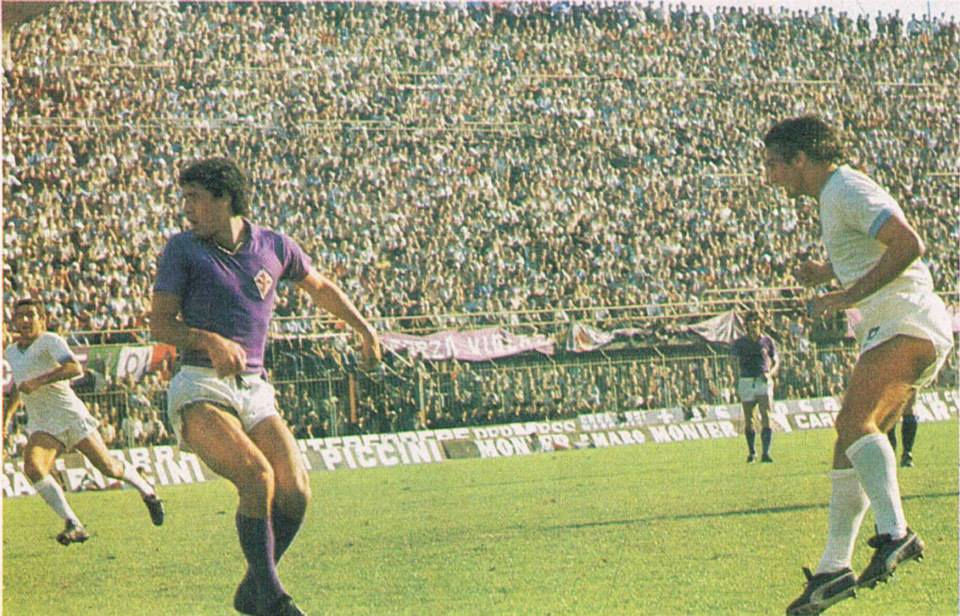
Lazio produced one of the most intelligent performances of the early 1976–77 season to win in Florence, beating Fiorentina 1–0 in their first away game of the championship.
Bruno Giordano's goal was a superb piece of opportunism and technique, but the victory owed just as much to the collective discipline of Luís Vinício's side. Lazio recognised their limitations, adapted their game to the opposition and, particularly in the first half, gave Fiorentina almost nothing.
The visitors' principal objective was to prevent Giancarlo Antognoni from dictating the game. Ciccio Cordova was primarily responsible for keeping the Fiorentina playmaker under control, while Roberto Badiani alternated with him in tracking the home side's most dangerous player. Luciano Re Cecconi protected the right side of midfield, while Vicenzo D'Amico kept close to Marco Rossinelli.
It worked.
Fiorentina, despite fielding three forwards in Gianfranco Casarsa, Claudio Desolati and Giuliano Bertarelli, struggled to create anything substantial. Lazio defended with a mixture of zonal and man-marking principles, maintaining a compact shape without becoming passive.
Wilson often positioned himself a step behind the other defenders, allowing him to make the kind of recovery challenges for which he was renowned.
At the back, young Lionello Manfredonia was outstanding.
Playing at stopper, Manfredonia appeared far beyond his years. He was decisive in the tackle, dominant in the air and remarkably composed whenever Fiorentina threatened. Desolati was effectively removed from the game, while Paolo Ammoniaci and Pietro Ghedin kept Bertarelli and Casarsa under control without abandoning their attacking responsibilities.
Lazio were also dangerous when they went forward.
Five minutes before the opening goal, Renzo Garlaschelli had already gone close after a prolonged move involving D'Amico. He had beaten the goalkeeper, only for Mauro Della Martira to clear his effort from the goal line.
Then, shortly after the half-hour mark, Lazio produced the move that ultimately decided the match.
Cordova carried the ball out of defence and found Re Cecconi, who took a few steps before opening the play towards Garlaschelli on the right. Garlaschelli released Ammoniaci, and the full-back accelerated all the way to the byline before delivering a long cross into the Fiorentina penalty area.
Giordano had already read what was coming.
Moving towards the left and slipping behind Della Martira, he found himself perfectly positioned as Ammoniaci's cross sailed over the defender. Giordano met it with a header, remarkably finding time to aim his effort towards the far side of the goal.
The ball flew past Massimo Mattolini and nestled inside the post.
Fiorentina 0–1 Lazio.
It was a goal of genuine quality, reminiscent of the header with which Pierino Prati had scored for Milan at Sampdoria the previous week. For Giordano, it was another sign that he was beginning to establish himself as a forward of real promise.
But his celebration lasted barely two minutes.
While attempting to control a high ball, Giordano suffered a strain to his right groin. He tried to continue after speaking to Vinício and club doctor Renato Ziaco, but he was clearly struggling and eventually had to leave the field towards the end of the first half. His place was taken by former Como forward Renzo Rossi.
Lazio nevertheless almost doubled their advantage before the interval, with Garlaschelli and Badiani both missing chances.
At half-time, Vinício's plan had worked almost perfectly.
After the break, however, the match changed completely.
Without Giordano, Lazio lost much of their movement up front. Rossi struggled to escape the close attention of Giancarlo Galdiolo and could not reproduce the pace and mobility of the injured Roman. Re Cecconi continued to cover enormous amounts of ground, but Lazio were increasingly forced backwards as Fiorentina launched wave after wave of attacks.
Antognoni began to find more space, while the home side looked increasingly desperate to force an equaliser.
Carlo Mazzone introduced Maurizio Restelli in the 58th minute, replacing Rossinelli, as Fiorentina increased the pressure. Lazio were now defending deep and frequently found themselves having to clear dangerous balls from crowded situations inside their own penalty area.
Their biggest escape came in the 76th minute.
Badiani allowed a ball to bounce behind him inside the area, giving Della Martira the opportunity to advance towards Pulici. The Fiorentina defender unleashed a fierce shot which beat the Lazio goalkeeper but struck the post.
It was the moment when Lazio came closest to surrendering their lead.
The pressure continued into the final minutes. Antognoni, despite having spent much of the afternoon trapped by Cordova and Badiani, still possessed the ability to produce something extraordinary. With two minutes remaining, he struck a ferocious free-kick that seemed destined for the corner.
But Felice Pulici had other ideas.
The Lazio goalkeeper launched himself towards the top corner and produced a spectacular save to preserve the lead.
It was the final major intervention in a match that had begun with Lazio controlling everything and ended with the visitors fighting desperately to protect the advantage Giordano had given them.
The young striker had provided the decisive touch; Manfredonia had looked like a veteran at the back; Re Cecconi had covered every blade of grass; Cordova and Badiani had neutralised Antognoni for long periods; and Pulici had supplied the save that finally secured the points.
Lazio had not overwhelmed Fiorentina.
They had outthought them.
Who played for Fiorentina
Mattolini, Galdiolo, Rossinelli (58' Restelli), E.Pellegrini, Della Martira, S.Zuccheri, Casarsa, Caso, Desolati, Antognoni, Bertarelli
Substitutes: Ginulfi, Tendi
Manager: Mazzone
Who played for Lazio
F.Pulici, Ammoniaci, Ghedin, Wilson, Manfredonia, Cordova, Garlaschelli, Re Cecconi, Giordano (43' R.Rossi), D'Amico, Badiani
Substitutes: Garella, Agostinelli
Manager: Vinicio
Referee: Barbaresco
Goal: 33’ Giordano
What happened next
In the first six games the Biancocelesti had done well and were fourth. Vinicio had introduced a few young players to the squad: Bruno Giordano, who had played well the previous year in Serie A both with and in place of Giorgio Chinaglia, plus Lionello Manfredonia and Andrea Agostinelli.
On December 4 Maestrelli died. The Biancoceleste derby win was the last present his boys were able to give him. Furthermore, on January 18 Luciano Re Cecconi was shot by a jeweller as he walked into his shop. He was only 28 years of age.
Despite all this the season was a great one on the pitch and Lazio surprised everybody by arriving fifth and qualifying for the UEFA Cup. A young team with experienced players too, a great cocktail that worked well.
Three players had the most appearances this season: Badiani, Cordova and Pulici (34). Top scorer was Giordano with 13 goals overall.
Lazio Jersey 1976-77
Image source: SS Lazio Museum (first). Other two reproduced with AI.
A season of several shirts, marked by a slightly deeper shade of celeste and, ultimately, by the tragedy of Luciano Re Cecconi
The 1976–77 season saw Lazio wear several different versions of their traditional celeste shirt, reflecting a period when there was still considerable variation in the design and manufacture of football jerseys.
One of the first shirts used that season was a summer short-sleeved version produced by Tuttosport, made from a particularly lightweight cotton in a plain light celeste. It featured the classic V-neck, finished with white cuffs, while the white shirt number was made from smooth plastic and sewn directly onto the shirt.
The shirt had visible stitching along the sides and shoulders, while a Tuttosport label was positioned centrally inside the collar.
Another version worn during the season had a slightly deeper shade of celeste than Lazio's traditional colour. This shirt was distinguished by a thin white trim around the collar and celeste cuffs, again edged in white. The numbers were made from white plastic.
Tuttosport supplied several different Lazio shirts during the campaign, including both a lightweight short-sleeved cotton version for warmer weather and a long-sleeved woollen version. Another set of shirts was produced by Ennerre, underlining the variety of equipment used by Lazio during the period.
The different versions are a reminder of how football shirts were made and supplied in the 1970s. Unlike the increasingly standardised modern game, clubs could use different materials and manufacturers during the same season, with shirts adapted to the weather and the practical requirements of the players.
But the most poignant shirt associated with the 1976–77 season was one that was never worn.
Luciano Re Cecconi had been one of the defining figures of Lazio's great side of the early 1970s. Signed from Foggia in August 1972 by his former coach Tommaso Maestrelli, the blond midfielder quickly became one of the most popular players among the Lazio supporters.
During the 1976–77 campaign, however, his season was interrupted by a serious injury suffered on 24 October 1976. Re Cecconi was expected to return after the Christmas break and spent the final months of the year undergoing rehabilitation.
His return was planned for the beginning of 1977. Lazio even had a new Tuttosport shirt prepared for him.
He would never wear it.
On 18 January 1977, Re Cecconi was tragically shot and killed by a jeweller in Rome. The Lazio community was devastated.
The final shirt prepared for the “Angelo biondo” therefore became something far more than a piece of football equipment. It was intended for his return to the pitch, but instead became a poignant symbol of a player whose life and career had been cut tragically short.
Source


Comments